.svg)
Tropical Plant Database - Plant Details
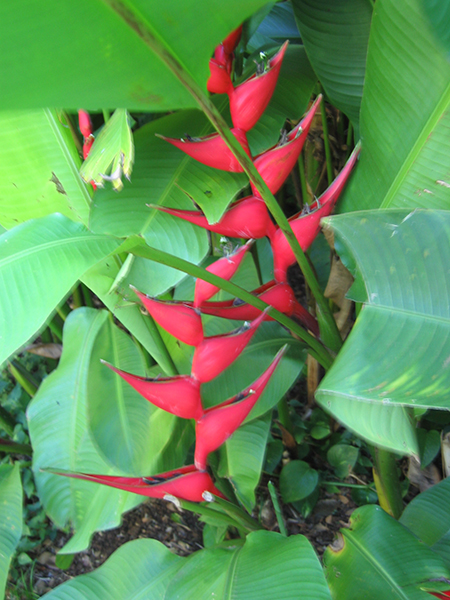
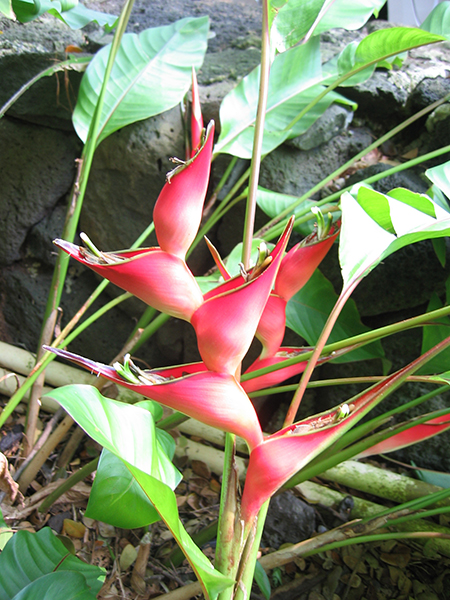
Heliconia stricta


Click on any heading above to view more information about this plant
Conservation Status
- IUCN: Not Evaluated
- USFWS: None
Family: HELICONIACEAE
Genus: Heliconia
Species: stricta
Species Author: Huber
Genus: Heliconia
Species: stricta
Species Author: Huber
Foliage is banana like with waxy white coating on stems and lower midrib.
Lobster claw heliconia, slightly spiraled base and cheek with narrow maroon-green margins on upper lip and tip. Height 3 to 5 in. Full sun to 30 % shade. Foliage is banana like with waxy white coating on stems and lower midrib.
Lobster claw heliconia, slightly spiraled base and cheek with narrow maroon-green margins on upper lip and tip. Height 3 to 5 in. Full sun to 30 % shade. Foliage is banana like with waxy white coating on stems and lower midrib.
Heliconias have become increasingly popular as decorative flowers, especially in those regions where they cannot be grown in the garden.
Heliconia are grown for their beautiful, brilliant colorful flowering bracts. They require bright light and are heavy feeders of any well balanced fertilizer.
(Kepler, A. K. 1999. Exotic Tropicals of Hawaii.)
Heliconia are grown for their beautiful, brilliant colorful flowering bracts. They require bright light and are heavy feeders of any well balanced fertilizer.
(Kepler, A. K. 1999. Exotic Tropicals of Hawaii.)
Heliconias are natives to Central and South America-the Amazon rainforest- and some islands of the South Pacific. Their easy cultivation and spectacular presence have made them favorite garden subjects throughout the world.
Species Interconnections and Interdependencies: In the American Tropics, hummingbirds are the exclusive polinators of red, yellow , pink and orange heliconias while nectar feeding bats are the polinators of green heliconias.
(Kepler, A. K. 1999. Exotic Tropicals of Hawaii.)
(Kepler, A. K. 1999. Exotic Tropicals of Hawaii.)
Although Heliconias flourish in the humid lowland tropics at elevations below 1500 feet, surprisingly, the greatest number of species are found in middle elevation rain and cloud forest habitats. The most remarkable members of the genus inhabit open sites in secondary growth along roads, riverbanks and in patches of light in the forest.
(Kepler, A. K. 1999. Exotic Tropicals of Hawaii.)
(Kepler, A. K. 1999. Exotic Tropicals of Hawaii.)
- 018351 - collected by Tim Flynn in 1987
- 018352 - collected by Tim Flynn in 1987
- 018353 - collected by Tim Flynn in 1987
- 018354 - collected by Tim Flynn in 1987
- 006636 - collected by Derral Herbst in 1990
- 059005 - collected by Tim Flynn in 1990
- 059006 - collected by Tim Flynn in 1990
- 059007 - collected by Tim Flynn in 1990
- 059008 - collected by Tim Flynn in 1990
- 059009 - collected by Tim Flynn in 1990
- 026746 - collected by Tim Flynn in 1990
- 026745 - collected by Tim Flynn in 1990
- 026744 - collected by Tim Flynn in 1990
- 023017 - collected by Tim Flynn in 1990
- 058882 - collected by Tim Flynn in 1990
- 058883 - collected by Tim Flynn in 1990
- 058837 - collected by Tim Flynn in 1990
- 058838 - collected by Tim Flynn in 1990
- 058998 - collected by Tim Flynn in 1990
- 058805 - collected by Tim Flynn in 1990
- 058806 - collected by Tim Flynn in 1990
- Unassigned - collected by Tim Flynn in 1990
- Unassigned - collected by Tim Flynn in 1990
- 066458 - collected by Tim Flynn in 1990
- 058877 - collected by Tim Flynn in 1990
- 058872 - collected by Tim Flynn in 1990
- 027382 - collected by Tim Flynn in 1992
- 027383 - collected by Tim Flynn in 1992
- 018022 - collected by Tim Flynn in 1995
- 061172 - collected by Madelaine Bartlett in 2008
We currently have 30 herbarium specimens for Heliconia stricta in our collection. Click on any specimen below to view the herbarium sheet data.