.svg)
Tropical Plant Database - Plant Details
Sphagneticola trilobata


Click on any heading above to view more information about this plant
Conservation Status
- IUCN: Not Evaluated
- USFWS: None
Family: ASTERACEAE
Genus: Sphagneticola
Species: trilobata
Species Author: (L.) Pruski
Genus: Sphagneticola
Species: trilobata
Species Author: (L.) Pruski
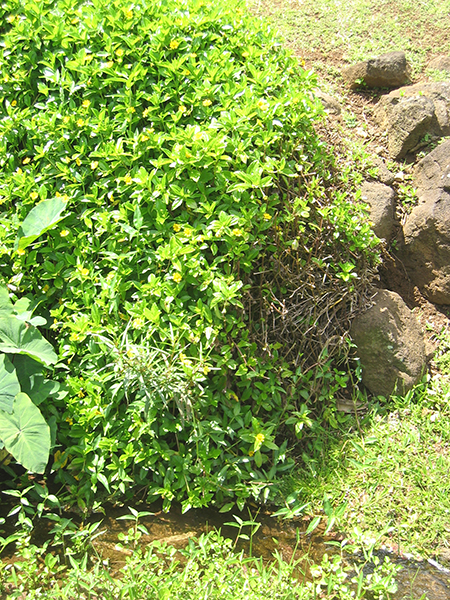
Sphagneticola trilobata is a creeping, mat-forming perennial herb with rounded stems that root at the nodes. The leaves are fleshy, ovate and irregularly toothed, about 4-9 cm long, (1.5-) 2-5 cm wide, usually with a pair of lateral lobes. Blooms profusely with 1" yellow-orange daisy-like flowers, borne singly on the end of each stem.
(Wagner, W.L., D.R. Herbst and S.H. Sohmer. 1999. Manual of the Flowering Plants of Hawai'i.)
(Wagner, W.L., D.R. Herbst and S.H. Sohmer. 1999. Manual of the Flowering Plants of Hawai'i.)
Sphagneticola trilobata is a beautiful ground cover in warm climates, especially good for soil retention and erosion control. This herb is very attractive because of its almost constant and prolific blooming. It grows well under trees and in poor soil, as well as a hanging basket species.
(Information for this species compiled and recorded by Camelia Cirnaru, NTBG Consultant.)
(Information for this species compiled and recorded by Camelia Cirnaru, NTBG Consultant.)
This creeping herb is native to the tropics of Central America and West Indies.
(Wagner, W.L., D.R. Herbst and S.H. Sohmer. 1999. Manual of the Flowering Plants of Hawai'i.)
(Wagner, W.L., D.R. Herbst and S.H. Sohmer. 1999. Manual of the Flowering Plants of Hawai'i.)
Sphagneticola trilobata has become naturalized in many wet tropical areas of the world. It forms a dense ground cover, crowding out and/or preventing regeneration of other species.
If Sphagneticola trilobata becomes established in plantations, it will compete with crops for nutrients, light and water and reduce crop yields. It rapidly escapes from gardens to roadsides and plantations, where it can overgrow plants and develop into a thick ground cover.
(Niue Department of Agriculture, Forestry and Fisheries. 2001.)
(PIER. 2003.)
If Sphagneticola trilobata becomes established in plantations, it will compete with crops for nutrients, light and water and reduce crop yields. It rapidly escapes from gardens to roadsides and plantations, where it can overgrow plants and develop into a thick ground cover.
(Niue Department of Agriculture, Forestry and Fisheries. 2001.)
(PIER. 2003.)
- 004278 - collected by Thomas B. Croat in 1978
- 095618 - collected by Derral Herbst in 1984
- 004279 - collected by Tim Flynn in 1987
- 027164 - collected by Jacques Florence in 1988
- 001741 - collected by Tim Flynn in 1989
- 003757 - collected by David H. Lorence in 1989
- 013172 - collected by Lynwood Hume in 1991
- 048583 - collected by Art Whistler in 1992
- 021073 - collected by David H. Lorence in 1996
- 028584 - collected by K. R. Wood in 1997
- 027787 - collected by David H. Lorence in 1997
- 024622 - collected by Tim Flynn in 1997
- 033554 - collected by Michael J. Balick in 1997
- 024672 - collected by Tim Flynn in 1997
- 043931 - collected by Art Whistler in 1998
- 034871 - collected by Michael J. Balick in 1999
- 030294 - collected by Hank Oppenheimer in 2000
- 039490 - collected by Steve Perlman in 2003
- 039567 - collected by David H. Lorence in 2003
- 045317 - collected by Hank Oppenheimer in 2006
- 045541 - collected by Hank Oppenheimer in 2006
- 045613 - collected by Hank Oppenheimer in 2006
- 045618 - collected by Hank Oppenheimer in 2006
- 045620 - collected by Hank Oppenheimer in 2006
- 049776 - collected by Nancy Vander Velde in 2009
- 067672 - collected by Nancy Vander Velde in 2009
- 091912 - collected by Aaron Teper in 2023
We currently have 27 herbarium specimens for Sphagneticola trilobata in our collection. Click on any specimen below to view the herbarium sheet data.