.svg)
Tropical Plant Database - Plant Details
Ipomoea batatas




Conservation Status
- IUCN: data deficient
- USFWS: None
Genus: Ipomoea
Species: batatas
Species Author: (L.) Lam.
Vernacular: Uala, Uwala, Kumara, Sweet Potato, Kamot ni beykngo - Yapese [Wong 398]
Synonyms: Convolvulus batatas L.
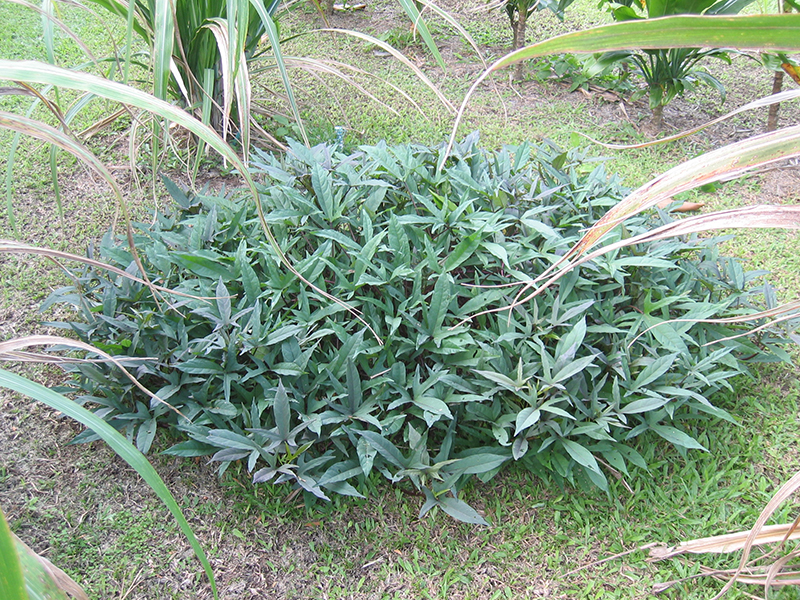
Sweet Potato is a tuberous-rooted perennial, usually grown as an annual. The top is herbaceous, drying back to ground each year. The stems are forming a running vine up to 4 m long, usually prostrate and slender, with milky juice, lateral stem-branches arising from the short stem and usually not branched. The leaves are ovate-cordate, borne on long petioles, palmately veined, angular or lobed, depending on variety, green or purplish. The flowers are white or pale violet, axillary, funnel-shaped, borne singly or in cymes on short peduncles. Fruits are pods with 1-4 seeds per pod, flattened, hard-coated, angular. (Reed. 1976.)
Some varieties of 'Uala in ancient days were used medicinally. 'Uala was used as a tonic during pregnancy and to induce lactation. Other varieties were said to cure asthma. 'Uala was also used as a laxative, and could be prepared as a gargle for sore throat and to reduce phlegm. Raw 'Uala mixed with Ti stem was used when it was necessary to induce vomiting. (Krauss, B. H. 1993. Plants in Hawaiian Culture.) (Kepler, A. K. 1998. Hawaiian Heritage Plants.)
One variety of 'Uala was used as fish bait, while old vines and leaves of 'Uala were placed beneath floor mats as padding. (Krauss, B. H. 1993. Plants in Hawaiian Culture.) (Kepler, A. K. 1998. Hawaiian Heritage Plants.) (Information for this species compiled and recorded by Camelia Cirnaru, NTBG Consultant.)
'Uala is thought to be of tropical South American origin, and was brought to Hawai'i by early Polynesian settlers as an important staple in their diet. There are many varieties of Ipomoea batatas, most maturing in 3-7 months from time of planting. (Krauss, B. H. 1993. Plants in Hawaiian Culture.) (Kepler, A. K. 1998. Hawaiian Heritage Plants.)
The leaves of 'Uala may be steamed, boiled or baked. The tuber is a carbohydrate. A good source of Vitamin A, calcium and phosphorus, most of the nutrients are near the skin. Therefore, it is nutritionally best to steam or bake the potatoes in their scrubbed skins in an oven or in an imu, rather than to boil them. If mixed with water, the cooked, skinned and mashed 'Uala makes a sweet potato poi. The tubers and greens are also used as food for livestock, especially pigs. (Krauss, B. H. 1993. Plants in Hawaiian Culture.) (Kepler, A. K. 1998. Hawaiian Heritage Plants.)
Kamapua'a is said to be the god of the Sweet Potato. This god has a pig-like snout, making it possible for him to root up the tubers. "He 'uala ka 'ai ho'ola koke i ka wi." "The Sweet Potato is the food that ends famine quickly." "The Sweet Potato is a plant that matures in a few months." (Krauss, B. H. 1993. Plants in Hawaiian Culture.) (Kepler, A. K. 1998. Hawaiian Heritage Plants.)
- 054685 - collected by Relio Lengsi in Unknown
- 023290 - collected by Clarence Y. C. Wong in 1948
- 066307 - collected by C. R. Long in 1965
- 091722 - collected by Art Whistler in 1972
- 091723 - collected by Art Whistler in 1973
- 004734 - collected by Tim Flynn in 1986
- 004733 - collected by Tim Flynn in 1986
- 004732 - collected by Tim Flynn in 1986
- 004731 - collected by Tim Flynn in 1986
- 003342 - collected by Lynwood Hume in 1990
- 009400 - collected by Tim Flynn in 1991
- 041640 - collected by Art Whistler in 1994
- 091550 - collected by Art Whistler in 1998
- 033564 - collected by Hank Oppenheimer in 2001
- 041419 - collected by Liloa Dunn in 2002
- 042364 - collected by Steve Perlman in 2004
- 085948 - collected by David E. Brussell in 2008
- 077691 - collected by Susan M. Deans in 2016
- 079964 - collected by Barbara Kennedy in 2017
- 087367 - collected by David H. Lorence in 2019
- 097697 - collected by Hayley Walcher in 2024
We currently have 21 herbarium specimens for Ipomoea batatas in our collection. Click on any specimen below to view the herbarium sheet data.