.svg)
Tropical Plant Database - Plant Details
Aptenia cordifolia


Click on any heading above to view more information about this plant
Conservation Status
- IUCN: Not Evaluated
- USFWS: None
Family: AIZOACEAE
Genus: Aptenia
Species: cordifolia
Species Author: (L. f.) Schwant.
Vernacular: Baby Sun-Rose, Rosa del Sol
Genus: Aptenia
Species: cordifolia
Species Author: (L. f.) Schwant.
Vernacular: Baby Sun-Rose, Rosa del Sol
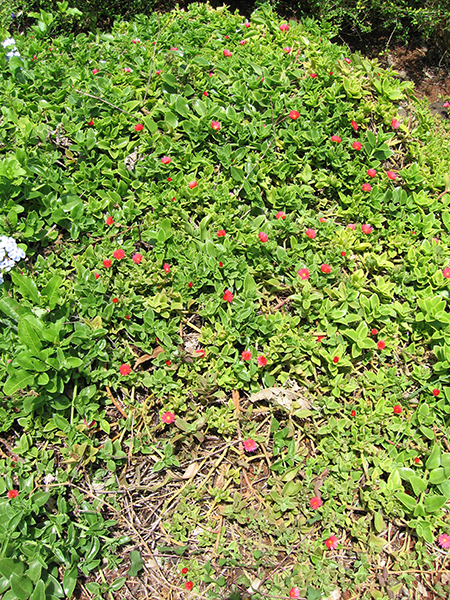
Aptenia cordifolia is a perennial evergreen herb with small, simple, heart-shaped, dark green succulent leaves. The moderately thick, succulent stems are flexible and easily snapped. They appear to crawl along the soil and hug the ground forming a tight, almost clipped appearance. Plants grow no taller than about 3 to 4 inches. The glossy foliage sparkling in the sun makes a superb backdrop for the purplish red daisies like flowers that blossom nearly year-round. The flowers are small with numerous petals bright pink to purple and they open only in sun. The fruits are minuscule capsules.
(Hickman, James C. 1993. The Jepson Manual.)
(Gilman, Edward F. 1999. Aptenia Cordifolia Fact Sheets.)
(Herre, H. 1971. The Genera of the Mesembryanthemaceae.)
(Hickman, James C. 1993. The Jepson Manual.)
(Gilman, Edward F. 1999. Aptenia Cordifolia Fact Sheets.)
(Herre, H. 1971. The Genera of the Mesembryanthemaceae.)
This charming dwarf succulent makes an excellent annual ground cover in a small landscape or rock garden. It is also grown in a hanging baskets.
(Gilman, Edward F. 1999. Aptenia Cordifolia Fact Sheets.)
(Information for this species compiled and recorded by Camelia Cirnaru, NTBG Consultant.)
(Gilman, Edward F. 1999. Aptenia Cordifolia Fact Sheets.)
(Information for this species compiled and recorded by Camelia Cirnaru, NTBG Consultant.)
Aptenia cordifolia is native to the Eastern Coastal Plains of South Africa. It has been introduced to California as a horticultural plant.
(Herre, H. 1971. The Genera of the Mesembryanthemaceae.)
(Herre, H. 1971. The Genera of the Mesembryanthemaceae.)
California Invasive Plant Council reports this species as invasive. It is listed as a wildland weed red alert as it has only recently become a problem. When watered, Red Apple overwhelms all neighboring vegetation, climbing over anything in its path. It has been used in landscaping adjacent to riparian areas within the urban interface, so it can easily spread into and dominate more natural riparian and wetland areas.