.svg)
The Science of Art – Why Botanical Illustration Matters
Plant lovers inherently appreciate beauty. We marvel at the arc of woody stems, the gentle curl of a leaf, or the way sunlight penetrates flower petals to reveal unexpected colors. The observation of plants is visually captivating and intellectually instructive whether we are arranging flowers at the kitchen sink, examining a stately tree in a garden, or collecting the seeds of an endangered shrub.
When we admire plants online, the internet offers up a flurry of photos, videos, and images that we click through like an old-fashioned movie projector. Increasingly, technology allows us to manipulate, enhance, and improve images with a few mouse clicks to create “picture perfect” photos of flawless flowers and plants that “pop.” In doing so, however, we run the risk of overlooking the centuries-old tradition of botanical illustration.
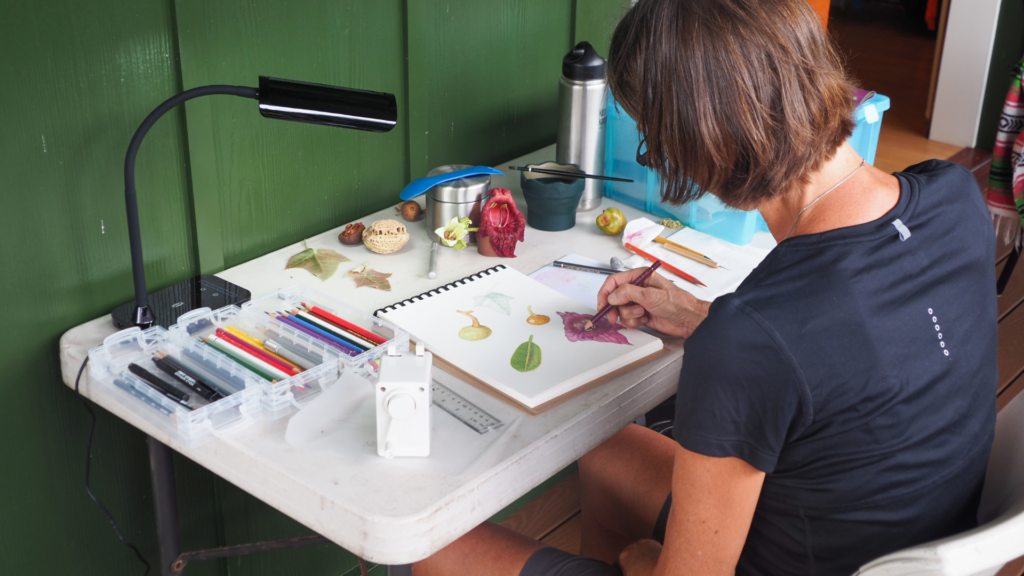
Botanical Illustration at NTBG
But in the world of botany, scientists and students, collectors and curators not only still appreciate, but absolutely depend on hand-drawn illustrations, paintings, and other traditional plant renderings.
At NTBG, we greatly value the importance of preserving and using historical botanical artwork in books and print collections. At our Botanical Research Center on Kauai, The Sam and Mary Cooke Rare Book Room houses our botanical art collection, including a complete set of the Banks Florilegium. We also host botanical illustration workshops at The Kampong in Miami and at NTBG headquarters where we help foster and exhibit the art of the NTBG Florilegium Society.
In an attempt to underscore and explain its timeless beauty and scientific value, we’ve asked our staff and partners to share their thoughts on why botanical illustration matters.
Why Drawing Plants Matters
“Botanical illustration serves as a connection between art and science and, in fact, is firmly planted in each discipline. As an addition to herbaria, it provides a detailed description of the species, whether as a pen and ink illustration or a richly colored watercolor, highlighting and magnifying hidden details and presenting them in an easily understood visual format. The illustrations give life and a three dimensional quality that contrasts and compliments the dried plant specimens found in herbaria.” —Tim Flynn, NTBG Herbarium Collections Manager
Important for Plant Science
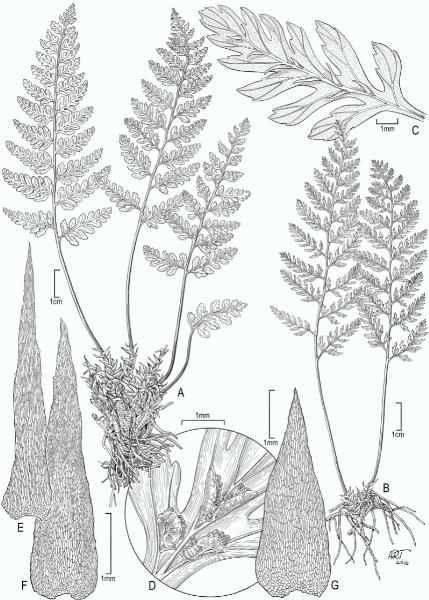
“Botanical illustration is an important aspect of plant science for a number of reasons. The illustrator emphasizes the important or diagnostic characters of a plant for the viewer. This is particularly true for pen-and-ink line drawings, which are generally used to illustrate or supplement descriptions of new plant species.
Indeed, the illustrator may see details that the botanist misses. Line drawings give the general aspect or habit of a plant, plus details of essential characters such as veins, pubescence or hairiness, flowers, fruit, and seeds that are magnified or shown in longitudinal or cross sections. These black and white line drawings may appear two-dimensional and flat, since they are usually drawn from dried, pressed herbarium specimens.
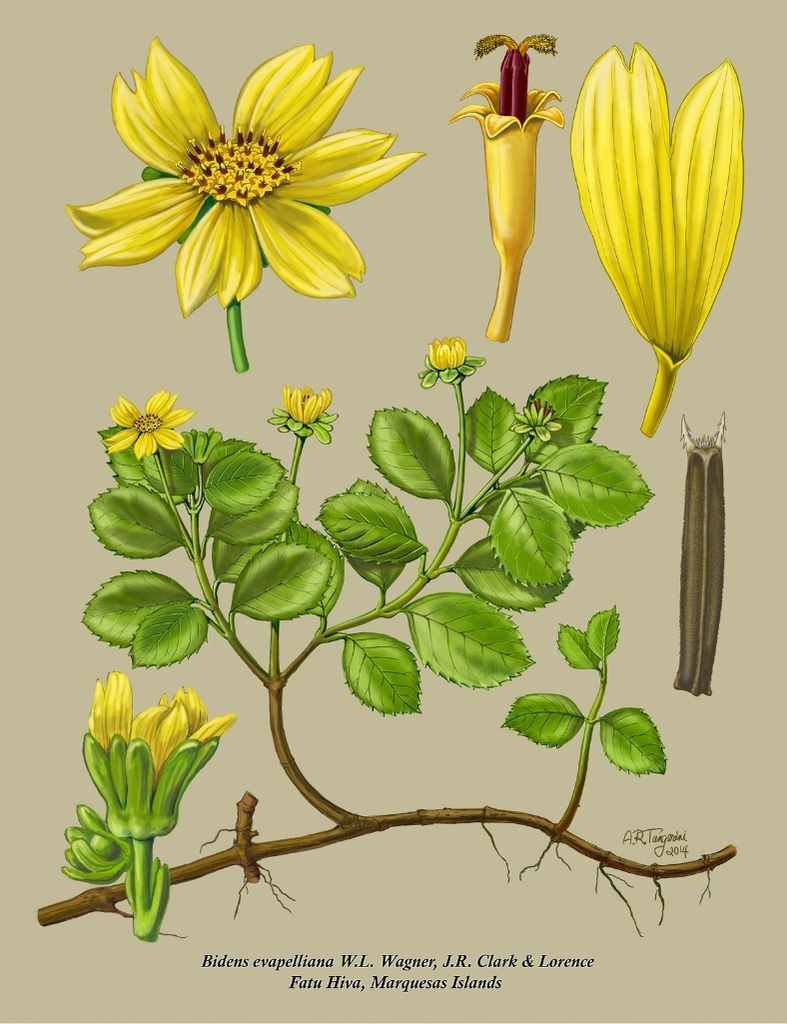
Illustration Preserves Plant Species
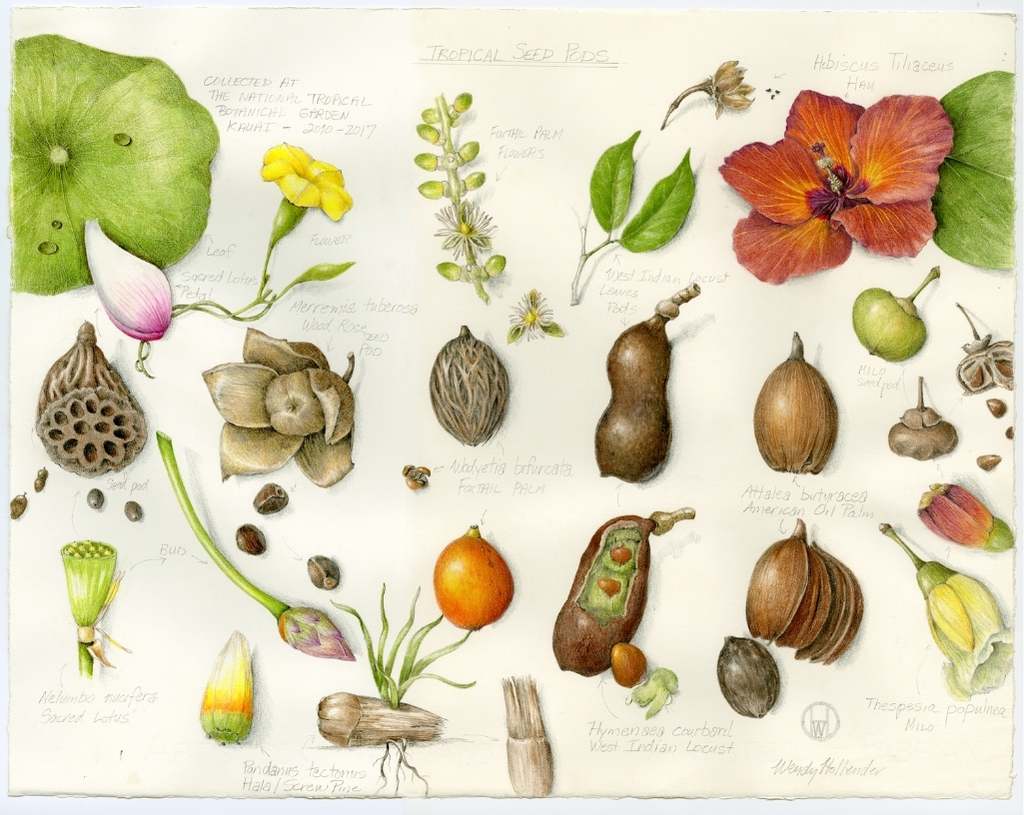
Another type of illustration is the florilegium style, usually done in watercolor or color pencil. This brings vibrant, lifelike color to the plant being illustrated and varies with each artist’s personal style. Details such as a close-up of the flowers or seed, a cross section of the fruit, a sketch of the habitat, growth habit of the plant, and even associated organisms such as herbivorous insects or pollinating birds or butterflies may be included in the illustration.
A botanical illustration can preserve a plant species, variety, or cultivar in books and journals almost in perpetuity, even if it goes extinct in the wild. Such was the case with a critically endangered Hawaiian endemic genus and species, Kanaloa kahoolawensis, first discovered and published only two decades ago but now known only from two plants in cultivation. Finally, illustrations can also help conservation efforts by creating public awareness and empathy for plants.”—Dr. David Lorence, NTBG Senior Research Botanist
“Explained simply, botanical illustrators and their works serve the scientist. They depict what a botanist describes, acting as the proofreader for the scientific description. Digital photography, although increasingly used, cannot make judgements about the intricacies of portraying the plant parts a scientist may wish to emphasize and a camera cannot reconstruct a lifelike botanical specimen from dried, pressed material.
Although illustrators now make greater use of digital research material and use the computer for digital illustrations, the thought process mediating that decision of every aspect of the illustration lives in the head of the illustrator. Whether pen and ink, pencil, watercolor, or the stylus on a drawing monitor, the tools only move at the discretion of the illustrator.
Historically, the illustration process follows the language of the scientist. Illustrators adapt media, presentation, and drawing styles to serve with current trends in scientific writing and to facilitate documentation of the scientific literature. However, the illustrator also has an eye for the aesthetics of botanical illustration, knowing that a drawing must capture the interest of the viewer to be a viable form of communication. Attention to accuracy is important, but excellence of style and technique used is also primary for an illustration to endure as a work of art and science.” —Alice Tangerini, Staff Illustrator at the Smithsonian Institution’s National Museum of Natural History, Department of Botany
I don’t simply copy how a plant looks but must explain plants through my drawing.
Wendy Hollender, Botanical Illustrator, Instructor, and Author
“The aesthetic beauty of botanical illustration has fascinated and inspired people for centuries but beyond its visual appeal, botanical drawings help identify and understand plants in a timeless manner. Its original purpose was to aid in plant identification for medicinal and culinary uses. Over the centuries, as the discipline developed, botanical illustration has proven itself invaluable in identifying newly discovered plants.
Carl Linnaeus, known as the father of modern taxonomy, and botanical illustrator Georg Dionysius Ehret, famously used botanical illustration to classify and describe the structure of plants. In the early nineteenth century, Belgian painter and botanist Pierre-Joseph Redouté captured the magnificent plants in the garden of Napoleon Bonaparte and Empress Joséphine de Beauharnais.
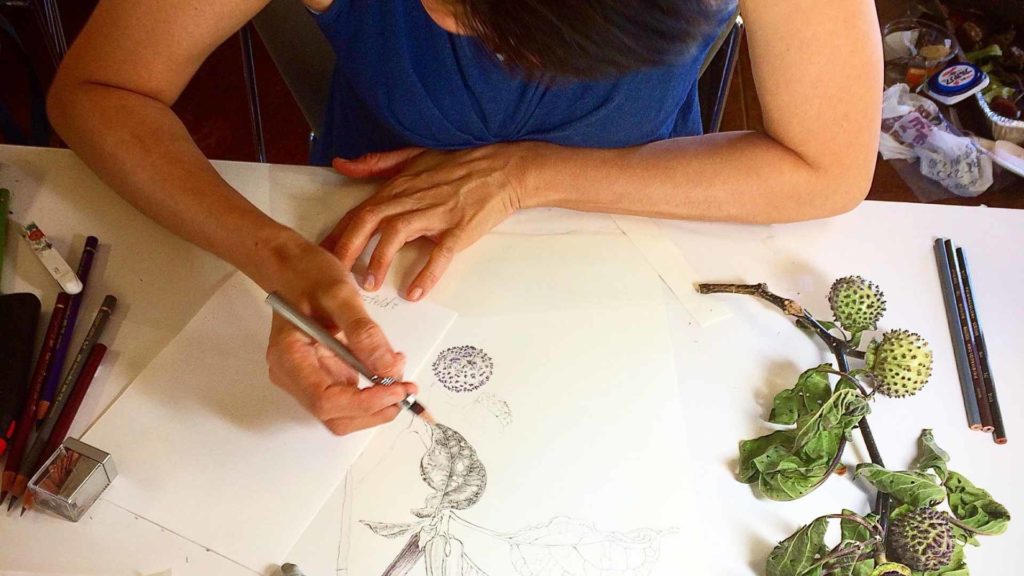
As a botanical illustrator, I don’t simply copy how a plant looks but must explain plants through my drawing. Botanical illustrations must reveal a plant’s morphological structure such as the arrangement of reproductive parts, leaves, and stems with a three dimensional quality.
Botanical illustration attracts and compels us. A pretty flower is not just a pretty flower, it has a specific purpose: to attract a pollinator. The flower’s visual appeal comes from colorful markings and its enticing scent lures the pollinator to the nectar within.
The scientific study of plants is essential for dealing with environmental changes, containing the spread of invasive plants, and saving endangered species, all issues addressed through botanical illustration. Although science has focused mostly on black and white pen and ink drawings, color can be used as well provided the artist capture a plant’s important structural elements.
What I find most alluring about botanical art is its seductive quality — drawing me in, feeding my desire to linger inside the mysterious center of the flower, looking through its leaves to another flower like an insect fluttering from blossom to blossom. Imbued with beauty and color, the botanical illustration seduces and attracts.”
—Wendy Hollender, Botanical Illustrator, Instructor, and Author
A botanical artist can tell the whole story of the plant
Sarah Roche, Botanical Artist, Teacher, and Education Director
“A botanical illustration is not primarily judged on its artistic beauty, but on its scientific accuracy. It must portray a plant with enough precision and detail for it to be recognized and distinguished from another species. The beauty of the drawing or painting is secondary to its scientific accuracy, but, in the hands of a talented botanical artist the illustration can go far beyond its scientific requirements.
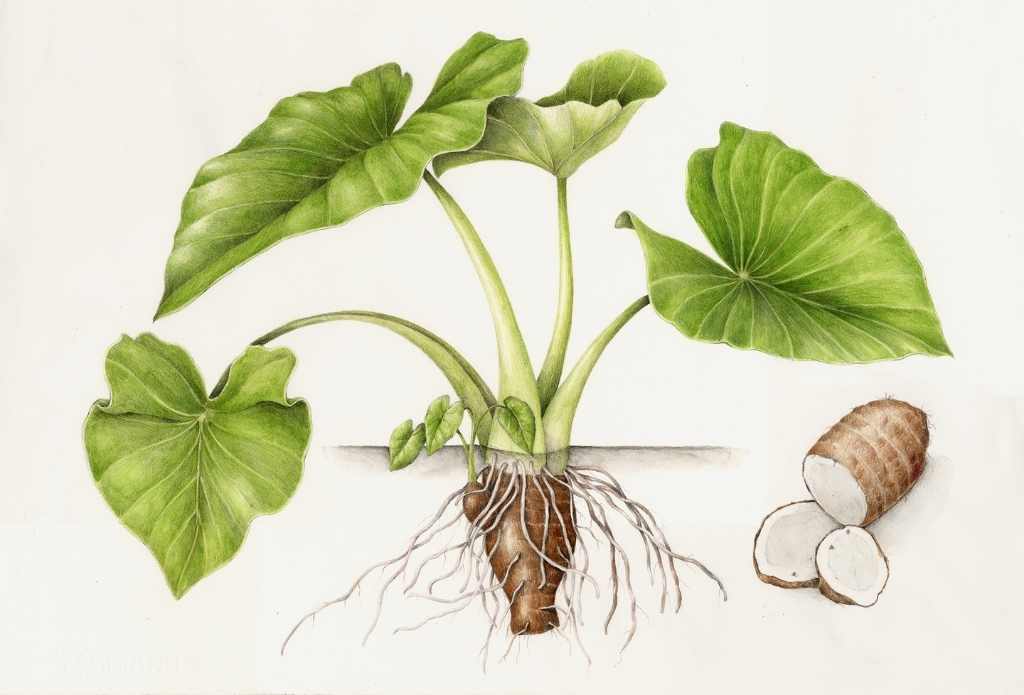
Photography can help inform but only drawing can emphasize the detail. A botanical artist can tell the whole story of the plant: what it looks like at any stage of its life cycle and in every season. Important details can be added at different magnifications so that the important features of the subject, not shown simultaneously in nature, can be displayed together to tell the whole story of the plant.”
—Sarah Roche, Botanical Artist, Teacher, and Education Director, Wellesley College Botanic Garden
The Art of Plant form and Evolution
“The tradition and practice of incorporating botanical illustration, watercolor, and other media into the process of describing new plant species continues to be a rich and profound contribution to the science of botany. For many, the written diagnosis or description of a species, although exacting and artistic in its own right, is often quite dull and lifeless. For me, time and time again, it is the manuscript’s botanical art contribution that brings to life the uniqueness and sublime diversity of the species being described.
The botanical art itself becomes a lens for the viewer to see deeper into the divine artistry of a plant’s form and evolution, which in most cases helps define the key parts that render the species new to science. It is true that well-taken photographs could suffice in displaying the unique qualities of the plant being studied, but for many it is the botanical artist’s rendition that is preferred and brings us closer to the subject.
What attracts us to botanical art? Perhaps it is the combination of careful attention to detail, along with the arduous internal human process of transforming a species’ visual likeness and character through the filter of mind and soul. Meticulously stirred together with the artist’s love for nature, the image flows through hands, communicating the importance and beauty of an ancient creation only newly described.” —Ken Wood, NTBG Research Biologist
This article was originally published in The Bulletin of the National Tropical Botanical Garden, Fall/Winter 2017
Into the Forests of Samoa
By Dr. David Lorence, Director, Science and Conservation
NTBG’s mission is unique among botanical gardens worldwide: our research is focused on plants of the Pacific, a diverse region covering 64 million square miles with thousands of tropical islands. Pacific floras are some of the most threatened on the planet, facing competition from non-native plants and animals, severe deforestation and habitat loss, and impacts from climate change.
Even today plant life on many Pacific islands remains poorly studied from a scientific perspective. With rampant deforestation and habitat alteration, expertise in plant taxonomy (classification and naming) and systematics is needed to identify and name new species so that researchers can best determine how to prioritize species for conservation.
Plants of the Pacific
Because of NTBG’s location in the central Pacific, our primary focus is on plants of Hawaii and other archipelagos including the Marquesas Islands, Samoa, and various islands in Micronesia and Melanesia. Over three decades, our scientists have discovered and named dozens of new species from Hawaii and the Marquesas Islands.
Last year, NTBG’s Herbarium Collections Manager Tim Flynn, Research Biologist Ken Wood, and I took part in a collecting expedition to Samoa along with Senior McBryde Research Fellow Dr. W. Arthur Whistler. The expedition was planned as Dr. Whistler was completing a written Flora of Samoa to be published as a book by NTBG and online at the Smithsonian Institution’s Pacific Island Floras website.
Although Dr. Whistler began studying the Samoan flora over 40 years ago and has collected thousands of herbarium specimens, a number of areas in Samoa remain poorly known and undocumented. Additionally, some species have not been seen or documented in over a century — and in one case in nearly two centuries. On our “to find” list were 16 species considered lost on the islands of Upolu and Savaii in Independent Samoa.
With grant funding from the National Geographic Society and the Mohamed bin Zayed Species Conservation Fund and additional support from NTBG’s McBryde Fund, we were able to organize a six-week botanical expedition between May – July 2016.
Exploring the Unknown
Our objectives were to conduct botanical field surveys of poorly known or unexplored areas of Samoa’s two main islands Upolu and Savaii; collect herbarium voucher specimens of the vascular plants, bryophytes (mosses and liverworts), and lichens; attempt to relocate rare and poorly known flowering plant and fern species; document the state of the natural vegetation and threats; and to help build local capacity in botany and the conservation of rare Samoan plant species.
This project is urgent because the threats to Samoa’s upland ecosystems will likely lead to reduced populations and possibly the loss of native species. We see great importance in contributing to the Flora of Samoa which will be an invaluable reference tool for Samoan conservation efforts.
The expedition included Mereia Tabua (University of the South Pacific, Fiji) who studies bryophytes (mosses and liverworts), and Melissa Johnson, then a Ph.D. candidate at Claremont College and Rancho Santa Ana Botanical Garden, California who studies the genus Cyrtandra (Gesneriaceae). Mereia, recipient of NTBG’s McBryde Young Investigator Fellowship for capacity building in tropical botany, worked closely with Tim while Melissa’s participation provided an opportunity to study Samoan Cyrtandra species in the field.
The two young investigators — one of whom was selected as our first McBryde Young Investigators Fellowship — were part of an effort that consisted of working alongside NTBG senior scientists and in close collaboration with Samoan Ministry of Natural Resources and the Environment (MNRE) and Samoan Conservation Society (SCS) staff, who were essential for organizing the expedition, obtaining collection permits, gaining permission to conduct field work on village lands, and obtaining guides and trail cutters.
After flying from Honolulu to Pago-Pago (American Samoa), we took a small plane to Upolu, where our team spent three weeks collecting, using the Vailima Botanical Garden as our base of operations. Later we traveled by inter-island ferry to Savaii, where I joined the others members of the expedition for the next three weeks.
In the Field
Fieldwork phases included valuable collaborations and training MNRE staff in identification and collecting techniques, gathering population data, taking GPS points, and collecting, pressing, and drying specimens. We generally drove into the mountains as far as possible then hiked to areas of relatively intact native vegetation which is mostly confined to mountain slopes and summits.
In addition to searching for the 16 rare species, we carried out general collecting in these remote and rarely-visited areas to document the vegetation, including both native and invasive species, for the Flora of Samoa project. We took photographs to supplement vouchered specimens, and collected leaf material in silica gel for molecular phylogenetic studies. Since ferns are of special interest to NTBG staff, including me, they were given special emphasis. The resulting images and collections contributed to the Flora of Samoa project and the joint Smithsonian Institution-NTBG website.
A population of an extremely rare fern not collected in over a century, Botrychium daucifolium (Ophioglossaceae), was also discovered on Savaii. Additional species collected but not on the list include two possibly undescribed ferns from Savaii.
In the end, we were able to achieve the majority of our goals collecting a total of 2,607 herbarium specimens, including 264 bryophytes, with the primary set deposited at Herbarium PTBG (the official name of NTBG’s herbarium). Ultimately, only two of the lost species were encountered during our field work, the others being either extremely rare or possibly extinct.
Because time and access to other remote mountainous areas on Savaii were limited, it is possible that additional field work could reveal populations of these species and perhaps even new species. Certainly more field work is needed, especially on Savaii. Three healthy populations of Abutilon whistleri, a rare tree belonging to the Malvaceae (hibiscus family) were located in montane wet forests on Savaii.
Lost but not Forgotten
Finally, all 16 “lost” Samoan species were added to The IUCN Red List of Threatened Species. Although not providing legal protection, red listing draws attention to a species rarity and threats they face and provides information to guide conservation measures. The expedition provided the opportunity to help grow NTBG’s herbarium collection with the addition of over 2,000 new herbarium specimens, another valuable contribution to the Flora of Samoa project.
Beyond our botanical goals, we were able to strengthen and make new contacts with colleagues in Samoa while laying the foundation for future collaborations. With respect to our rediscovered rare species, we were thrilled to find they were alive and well, and remain hopeful that others will eventually be found.
Raising Giants – Baobabs at The Kampong
By Larry Schokman, Director Emeritus, The Kampong
When describing a botanical garden’s living collection as priceless, it is meant in the truest sense of the word. The plants that comprise the living collection at The Kampong transcend monetary value. They are, after all, a living collection that represent eons of evolutionary change.
One of the most prized collections at The Kampong is the genus Adansonia[1] commonly known as baobab. There are only eight species in this genus and The Kampong has six of them (not many botanical gardens can make this claim!). Of the eight, six are endemic to Madagascar, the center of baobab diversity. Adansonia digitata is from sub-Saharan Africa and A. gregorii is native to arid Northwest Australia. A possible ninth species (A. kilima) in Africa has not yet been positively identified.
The Kampong Baobab Collection
The Kampong’s collection includes a 22-foot tall A. madagascariensis (the only red-flowering baobab) and A. rubrostipa whose swollen trunk will eventually assume the distinctive bottle shape for which baobabs are known. With the exception of A. digitata, all trees are less than 15 years old.
The name baobab can be traced back to the fruit markets of 16th century Cairo and was probably derived from the Arabic bu hibab meaning “many seeded fruit.” Carl Linnaeus, considered the father of modern taxonomy, named the genus Adansonia in honor of French botanist Michael Adanson, the first person to describe the tree (1757), calling it the “calabash tree.”
Within The Kampong’s collection, Adansonia digitata is the largest and imbued with greatest historical significance. The seed of this antediluvian giant was collected by Dr. David Fairchild in Dar es Salaam, Tanzania, on April 9, 1928 and planted at the USDA Chapman Field in Miami where it stood until it was blown down by Hurricane Cleo on August 29, 1964.
When The Kampong’s previous owner and “savior” Catherine Hauberg Sweeney[2] heard this fallen tree was scheduled to be destroyed, she offered to rescue and plant it at The Kampong. Transplanting this magnificent specimen was a horticultural success and was likely the first time a mature baobab of this size had been transplanted.
Withstanding the Test of Time
In time this giant baobab reestablished itself on the grounds of The Kampong until some five decades later it was knocked down for a second time when Hurricane Wilma[3] blasted The Kampong on October 24, 2005.
After I sent out an urgent appeal (as Director of The Kampong at that time), to our Board, Fellows, Members, and many neighbors and well-wishers, they responded with generosity beyond our wildest expectations. Their kind support took care of post-hurricane needs as well as the replanting of our fallen baobab which, without our supporters, might not have survived.
Time was of the essence if we were going to save this enormous tree that was lying like a wounded elephant sprawled from The Kampong into the adjacent Hissar property with the majority of its roots dangerously exposed to harsh sunlight. Using a backhoe and two agile tree climbers, in what was truly an “all hands on deck” effort, Kampong staff and volunteers cleaned up debris, pruned back damaged branches, and propped up the tree with the aid of the largest crane we could squeeze into The Kampong.
Once upright, we used four cables to anchor the baobab to neighboring trees. The large new hole in which the tree now stood was filled with decayed organic matter in order to persuade this shallow-rooted tree to anchor its roots firmly in the ground, and (hopefully) survive the wrath of future hurricanes. This may be the only baobab to have been transplanted in two different locations on two separate occasions. The two icons of The Kampong, Dr. David Fairchild and Dr. Catherine Sweeney, were intertwined in the history of this tree — quite an extraordinary coincidence.
In their natural habitats where they are not subject to hurricanes, the root systems of large baobabs run along the surface of the soil, rarely descending more than six feet below ground level. This adaptation, common to most succulents, allows the tree to take advantage of even the lightest precipitation, which is key to their survival in arid climes. It’s also why the growth rates of these huge trees can vary quite dramatically in areas of higher rainfall.
The swollen trunks of these succulent plants suddenly narrow just below the branch canopy, giving baobabs their bottle-shaped appearance. During winter, the leafless branches look like roots, earning the nickname “upside down tree.”
The original supposition was that baobabs store large amounts of water in their spongy trunks (up to 80 percent) for use during times of drought. Recent studies, however, refute this.
Apparently the large amount of water stored in its spongy tissue is specifically used for structural stability. If the water in their trunks were to drop below a certain point, the entire tree would collapse under the weight of its canopy. This is why they shed their leaves during dry periods. Reduced photosynthesis means diminished respiration.
The largest of The Kampong baobabs (A. digitata) used to shed its leaves in the winter for eight to ten weeks but now, because of the heavy mulching, it sheds its leaves for half that period of time. It also fruits more prolifically than before it was replanted, even though we do not have the specific animal pollinators from its native habitat.
Hurricane Irma
On September 10th, 2017, the 400-mile wide Category 5 monster Hurricane Irma tore into Florida’s Cudjoe Key with winds of 150 mph. The eye of the storm was 25 miles wide (the largest hurricane recorded in the Atlantic). By the time the outer bands of the northeast quadrant (the most destructive part of the hurricane) hit Miami, it was barely a Category 1 with sustained winds of up to 80 mph that lasted almost 12 hours. The Kampong received a mere four inches of rain during that time. The extravagance of nature’s savagery was compounded by multiple mini-tornadoes accompanying these winds.
One can only imagine the catastrophic impact that might have occurred if Miami had received a direct hit from that Category 5 hurricane with sustained wind speeds of 185 mph. We dodged the proverbial bullet.
The Kampong suffered considerable damage to its living collection even though the buildings were unscathed. Down went our giant baobab for the third time because of the domino effect of falling trees. The other Adansonia spp. are leafless but remain upright. The Kampong’s Director Craig Morell is making urgent preparations to prop up the giant baobab, as well as all other fallen trees on the property. The top one-third of its extensive canopy will be trimmed before it is uprighted. This operation will make the baobab lighter and make it less susceptible to storm damage. Regular, judicious pruning will prevent this tree from being blown down again.
[1] The genus Adansonia was originally in the Bombacaceae, but molecular studies have resulted in reassigning it to the sub-family Bombacoidae in the family Malvaceae (Mallow family)
[2] Catherine H. Sweeney purchased The Kampong in 1963 and donated it what was then known as the Pacific Tropical Botanical Garden. As a result, PTBG’s name was changed to National Tropical Botanical Garden by an act of the U.S. Congress in 1988
[3] In 2005, The Kampong was also impacted by Hurricane Katrina and Hurricane Rita
Q&A with NTBG Drone Pilot Ben Nyberg
NTBG’s drone specialist and GIS coordinator, Ben Nyberg, was featured in a Q&A by Mongabay regarding the use of drones for plant conservation. A link to the Q&A article can found here.
Roots ‘n Shoots Fun Run
Saturday, April 20, 2019 – 8:00am
Run, jog or walk a beautiful 5k course through McBryde Garden & Allerton Garden
National Tropical Botanical Garden and The Kaua‘i Marathon hosts 5th Annual Roots ‘n Shoots Fun Run
Kalāheo, Kaua‘i, HI (April 20th, 2019) – National Tropical Botanical Garden (NTBG) and The Kaua‘i Marathon are proud to present the 5th Annual Roots ‘n Shoots Fun Run on Saturday, April 20, 2019 at McBryde Garden and Allerton Garden. All ages are invited to run, jog or walk the beautiful 5k course through the gardens while learning about the diverse surrounding scenery.
Check-in will be at the NTBG South Shore Visitors Center parking lot located at 4425 Lāwa‘i Road (across from Spouting Horn) beginning at 6:00 a.m. Participants will then be shuttled to the start of the race. The Roots ‘n Shoots Fun Run will begin promptly at 8:00 a.m. near McBryde Garden’s Biodiversity Trail – a winding 800-foot path that showcases the evolution of Kaua‘i plant life over the last 450 million years. Along the trail, runners and walkers will enjoy an array of scenery including a rainforest, golden bamboo grove, tropical fruit trees, the Lāwa‘i Stream and magnificent views of the Pacific Ocean.
All participants will receive a free gift and access to the silent auction and drawing. Plus, they can enjoy a post-race continental breakfast catered by Living Foods Gourmet Market and Café with coffee provided by Kaua‘i Coffee Company.
Participants are encouraged to register early. Entry fees for registrations received by April 8, 2019 are $40 for adults and $30 for students (16 and under). After April 8, 2019, entry fees are $50 for adults and $40 for students (16 and under). Proceeds from the Fun Run will benefit The Kaua‘i Marathon’s associated charities. For more information or to register, visit thekauaimarathon.com.
McBryde Garden
4425 Lawai Road
Koloa , HI
See map: Google Maps
Dr. Michael S. Dosmann to be Awarded Fairchild Medal for Plant Exploration for 2019
Kalāheo, Kaua‘i, Hawai‘i, USA (January 15, 2019) — Dr. Michael S. Dosmann, Keeper of the Living Collections at the Arnold Arboretum of Harvard University, has been named the 2019 recipient of the David Fairchild Medal for Plant Exploration. In an announcement from its headquarters in Hawai‘i, the National Tropical Botanical Garden (NTBG) recognized Dosmann for his outstanding contributions to botanical exploration and horticulture.
The Fairchild Medal will be presented to Dosmann at a black-tie dinner at NTBG’s historical garden and former residence of plant explorer Dr. David Fairchild, The Kampong, in Coconut Grove, Florida on February 1, 2019. The following day he will present a public lecture entitled “Today’s Plant Explorer: Learning from the past to secure a better future.”
NTBG Environmental Journalism Program Now Accepting Applications
The Hawai‘i-based National Tropical Botanical Garden (NTBG) is now accepting applications for its Environmental Journalism (EJ) Program which is designed for professional journalists (staff or freelance) working in broadcast, print, and online media. The immersive five-day program provides a background in tropical botany, ecology, and conservation, and is designed to enhance well-informed, accurate reporting on environmental issues with a focus on tropical and island systems.
View the full press release and application at the NTBG.ORG Professional Development Page
NTBG Statement on Rapid Ohia Death
The news that one of the two fungal pathogens known to cause Rapid Ohia Death or ROD is now confirmed to be on Kauai is a serious concern. Ohia (Metrosideros spp.), the most abundant native tree in the state of Hawaii, is a foundation species that is essential to all of our wet and mesic forest ecosystems. As we learn more about this situation, I encourage the public to get informed about how to protect our forests and prevent the spread of this pathogen. We all need to implement the best practices that are being recommended by the rapid response team of experts and the State of Hawaii‘i’s Department of Land and Natural Resources (DLNR). At this time, we encourage you to follow DLNR for the latest news updates. — Chipper Wichman, President and CEO, National Tropical Botanical Garden
Kauai Rapid Ohia Death Video News Release, May 11, 2018 from Hawaii DLNR on Vimeo.
Hawaii Senator Mazie Hirono Introduces Bill to Promote Botanical Research
Hawaii Senator Mazie Hirono Introduces Bill to Promote Botanical Research
Legislation would support research, restoration, and use of native plants
FOR IMMEDIATE RELEASE
Kalāheo, Kaua‘i, Hawai‘i (July 23, 2018) – Hawai‘i Senator Mazie Hirono has introduced a bill that would support native plant research, encourage the hiring of botanists, and promote the use of native plants for projects on federal lands whenever possible.
In a press release, Sen. Hirono said, “Native plants play a crucial role in conserving and protecting our land, and are an important part of our culture.” Hirono added that the bill would provide resources to ensure land managers have the necessary tools and expertise to protect native plants.
The Botanical Sciences and Native Plant Materials Research, Restoration, and Promotion Act (S.3240) would advance plant research through grant programs within the Department of the Interior (DOI); support hiring and retention of botanists within DOI; give preference to using native plants in land management projects; promote inter-agency cooperation on native plant-related activities; and other directives.
National Tropical Botanical Garden (NTBG) President and CEO Chipper Wichman called introduction of the bill “a bright spot that recognizes the importance of perpetuating the native plant diversity of the United States, and the role of research. At a time when an effort has been launched in Washington to undermine the Endangered Species Act, this bill is even more critical in helping support research and conservation work, like that of NTBG, which is protecting our native species.”
NTBG Seed Bank and Laboratory Manager Dustin Wolkis noted that although Hawai‘i makes up less than one percent of the United States, it is home to over half the plant species listed under the U.S. Endangered Species Act. He added that although plants represent over half of all federally endangered species, they receive less than 4 percent of federal funds available for endangered species protection.
With more than 1,300 native plant species, 90 percent of which are found nowhere else, Hawai‘i has one of the highest rates of endemism in the world and is considered a “hotspot” of both biodiversity and plants threatened with extinction.
If passed into law, NTBG and similar plant science research and conservation organizations could benefit from the bill through new opportunities for people working in plant science and conservation fields, additional funding opportunities for programs designed to protect the environment, and a greater awareness and understanding of the value and importance of rare and endangered native plants across the United States.
The Botanical Sciences and Native Plant bill was introduced on July 18th by Sen. Hirono and co-sponsored by Senators Duckworth (IL), Van Hollen (MD), and Whitehouse (RI). A similar version of the bill has been introduced in the House of Representatives.
# # #
National Tropical Botanical Garden (www.ntbg.org) is a not-for-profit, non-governmental institution with nearly 2,000 acres of gardens and preserves in Hawai‘i and Florida. The institution’s mission is to enrich life through discovery, scientific research, conservation, and education by perpetuating the survival of plants, ecosystems, and cultural knowledge of tropical regions. NTBG is supported primarily through donations and grants.
Lower Limahuli Preserve Emergency Stream Debris Removal
The NTBG has issued a Request For Proposal for debris removal at the Lower Limahuli Preserve.