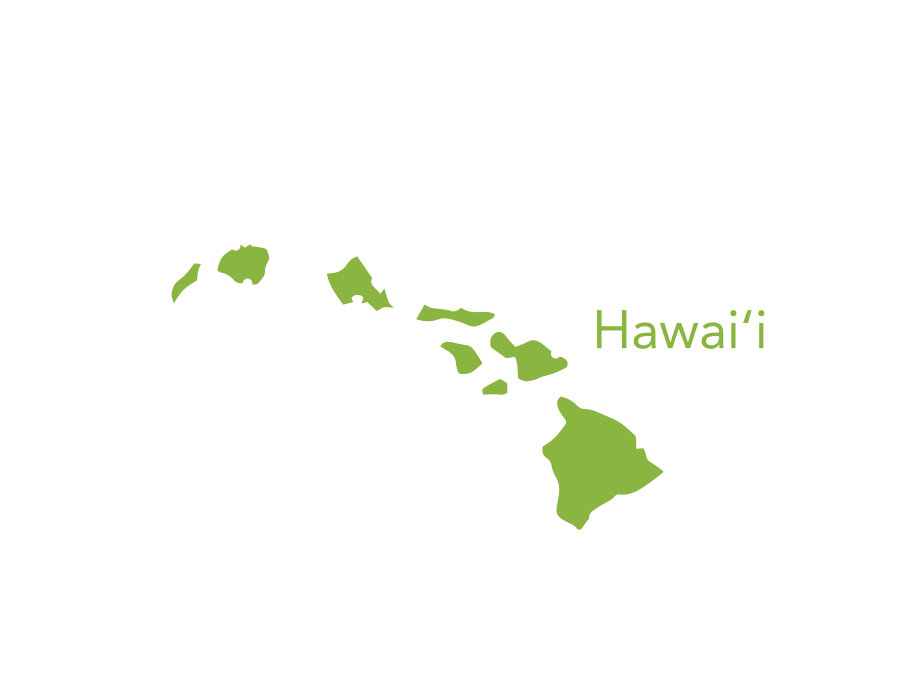
.svg)
Hybrid Forest Restoration Benefits Communities and Increases Resilience
An interdisciplinary research team from the University of Hawai`i at Mānoa (UHM) and the National Tropical Botanical Garden (NTBG) demonstrated how collaboratively-developed forest restoration in Limahuli Garden & Preserve (Limahuli) can increase community benefits and improve resilience at lower cost than standard forest restoration programs. Because conservation managers are increasingly faced with making restoration decisions constrained by multiple goals and limited budgets, the research team collaborated with conservation professionals at Limahuli to co-design research that will directly inform adaptive management.
Specifically, authors of a newly published study in the journal Conservation Letters asked how manager-defined ecological, hydrologic and cultural metrics of success and long-term managementcosts vary across different restoration strategies. The researchers focused on the ahupua`a of Hā`ena on Kaua`i Island, and evaluated unrestored forest and forests restored to different states—ranging from a pre-human arrival state, to a “hybrid” state that includes mixes of native and non-native species of cultural importance. Their study site was Limahuli Valley, a 400-hectare nature preserve managed by NTBG in the most biodiverse ecoregion of the Hawaiian archipelago, which is home to dozens of endangered plants and birds found nowhere else on earth. They found that restoring forest to a hybrid state provided many of the same services that a restored ‘pre-human’ state can provide, but at a much lower cost. They also found it increased two important services:cultural value and resilience to disturbance such as hurricanes.
The paper “Restoring to the Future: Environmental, Cultural, and Management Tradeoffs in Historical versus Hybrid Restoration of a Highly Modified Ecosystem” has a diverse team of authors from the natural and social sciences as well as natural resource managers: Kimberly M. Burnett, Tamara Ticktin, Leah L. Bremer, Shimona Quazi, Cheryl Geslani, Christopher A. Wada, Natalie Kurashima, Lisa Mandle, Pua`ala Pascua, Taina Depraetere, Dustin Wolkis, Merlin Edmonds, Thomas Giambelluca, Kim A. Falinski, and Kawika B. Winter.
“Restoring forests to a pre-human state on a landscape scale has been idealized, but—given the amount of functional diversity that has gone extinct in Hawai`i—such an approach is almost impossible, ecologically speaking. Beyond that, our research has shown that goal is economically impractical, and it isn’t the best way to engage community in restoration efforts,” said Dr. Kawika Winter, a multidisciplinary ecologist and Research Associate at NTBG who is the anchor author of the new study. “These results can be used by conservation practitioners to guide management actions, and to bring the community back into the forest while improving multiple ecological and social benefits; and do all this at lower costs than programs focused solely on historical restoration goals.”
The methods also have applications far beyond Hawai`i, particularly as conservation managers working in places with a history of cultural engagement with forests, and who are increasingly faced with decisions on how to fund and approach restoration efforts. This new research provides a framework to help managers identify restoration strategies addressing multiple goals in regions where restoration is challenging – areas where invasive species or other issues limit natural regeneration of native species, and/or where local populations depends on natural resources. Lower costs also offer the possibility of scaling-up, a critical consideration since island conservation is underfunded compared to continents.
Dr. Kimberly Burnett, Specialist with the University of Hawai`i Economic Research Organization and lead author of the study, said: “While conservation managers cannot make realistic decisions without considering costs, these type of tradeoff analyses are rare in restoration research. Our study provides a framework to consider these costs and benefits, while providing specific management direction for Limahuli and generalizable lessons for restoration strategies around the world.”
Dr. Tamara Ticktin, co-author on the study, Professor of Botany at UHM, and Principal Investigator on the National Science Foundation grant that funded the research, added: “Like any restoration strategy, hybrid forest restoration also has its limitations. Our study concluded that hybrid forests can be an excellent strategy within a landscape mosaic that also includes more expensive restoration strategies needed to preserve the most endangered species. The value of our multidisciplinary approach is that it provides a powerful tool for resource managers to take into consideration the different metrics that are important to them, and to make more informed decisions about what thatlandscape mosaic of restored forest could look like.”
This study was supported through funding from a National Science Foundation grant to the University of Hawai`i.
* * *
Citation: Burnett KM, Ticktin T, Bremer LL, et al. Restoring to the future: Environmental, cultural, and management trade-offs in historical versus hybrid restoration of a highly modified ecosystem. Conservation Letters. 2018;e12606. https://doi.org/10.1111/conl.
The Kampong named one of Miami’s Hidden Gems
The Destination Immersion Blog recently named NTBG’s Kampong Garden as one of the top hidden gems in Miami. Read a snippet of the article below and see the feature article on the Destination Immersion Blog.
The Kampong is a spectacular botanical garden to say the least. Situated in Coconut Grove, The Kampong is part of the not-for-profit National Tropical Botanic Garden institution and was established by the noted horticulturist Dr David Fairchild.
Director of The Kampong, Craig Morell, spoke to us about the special nature of the attraction: “The Kampong of the National Tropical Botanical Garden is a hidden garden gem in Miami, harkening to an era long gone. The home of famed plant explorer Dr David Fairchild, the property dates back over 150 years. Dr Fairchild introduced many early varieties of the tropical fruits, grains and spices we eat today, as he travelled the world to find better food to feed America. His elegant home sits on the highest natural stone ridge in the county and overlooks Biscayne Bay and Key Biscayne. There is a scenic walk right down to the bayfront.
NTBG Research published in Sustainability Journal
Researchers from the National Tropical Botanical Garden co-authored three papers for the September issue of the open-access journal Sustainability.
1. Agroforestry Standards for Regenerative Agriculture by Craig R. Elevitch, D. Niki Mazaroli and Diane Ragone
Sustainability 2018, 10(9), 3337; https://doi.org/10.3390/
Agroforestry is increasingly being recognized as a holistic food production system that can have numerous significant environmental, economic, and social benefits. This growing recognition is paralleled in the USA by the budding interest in regenerative agriculture and motivation to certify regenerative practices. […] Read more.
(This article belongs to the Section Sustainable Agriculture, Food and Wildlife)
2. The Social-Ecological Keystone Concept: A Quantifiable Metaphor for Understanding the Structure, Function, and Resilience of a Biocultural System by Kawika B. Winter, Noa Kekuewa Lincoln and Fikret Berkes
Sustainability 2018, 10(9), 3294; https://doi.org/10.3390/
Social-ecological system theory draws upon concepts established within the discipline of ecology, and applies them to a more holistic view of a human-in-nature system. We incorporated the keystone concept into social-ecological system theory, and used the quantum co-evolution unit (QCU) to quantify biocultural […] Read more.
(This article belongs to the Special Issue Biocultural Restoration in Hawaiʻi)
3. Linking Land and Sea through Collaborative Research to Inform Contemporary applications of Traditional Resource Management in Hawai‘i by Jade M.S. Delevaux, Kawika B. Winter, Stacy D. Jupiter, Mehana Blaich-Vaughan, Kostantinos A. Stamoulis, Leah L. Bremer, Kimberly Burnett, Peter Garrod, Jacquelyn L. Troller and Tamara Ticktin
Sustainability 2018, 10(9), 3147; https://doi.org/10.3390/
Across the Pacific Islands, declining natural resources have contributed to a cultural renaissance of customary ridge-to-reef management approaches. These indigenous and community conserved areas (ICCA) are initiated by local communities to protect natural resources through customary laws. To support these efforts, managers require […] Read more.
(This article belongs to the Special Issue Biocultural Restoration in Hawaiʻi)
Selling Threatened Plants to Save Them
The International Center for Tropical Botany is dedicated to the conservation and sustainable use of tropical plants through research, education and outreach. It is a partnership between FIU and the National Tropical Botanical Garden. ICTB professor and Conservation Ecologist, Hong Liu, says selling threatened plants could save them from extinction in research recently published in Conservation Biology. Read the full article at Phys.org.
Hong Liu et al. Conservation impacts of commercial cultivation of endangered and overharvested plants, Conservation Biology (2018). DOI: 10.1111/cobi.13216
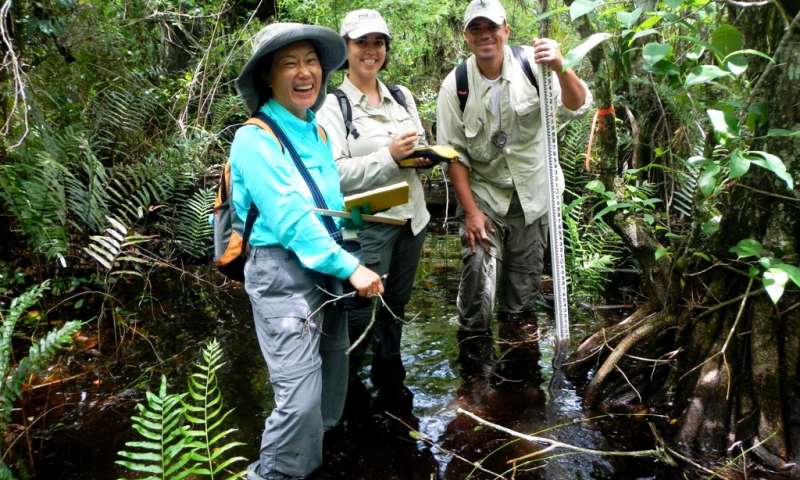
Extreme Botany: The Precarious Science of Endangered Rare Plants
National Tropical Botanical Garden and our partners across the state and country were featured in the recent article published by Yale School of Forestry and Environmental Studies Extreme Botany: The Precarious Science of Endangered Rare Plants.
Read an excerpt below from author Janet Marinelli and the full article at YaleEnvironment360.
—
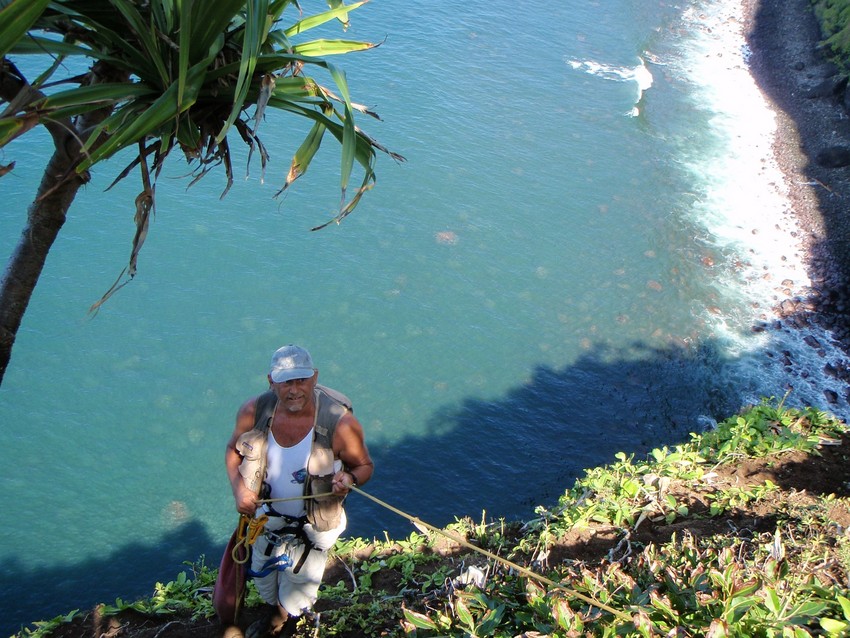
They don’t make the headlines the way charismatic animals such as rhinos and elephants do. But there are thousands of critically endangered plants in the world, and a determined group of botanists are ready to go to great lengths to save them.
To save plants that can no longer survive on their own, Steve Perlman has bushwhacked through remote valleys, dangled from helicopters, and teetered on the edge of towering sea cliffs. Watching a video of the self-described “extreme botanist” in action is not for the faint-hearted. “Each time I make this journey I’m aware that nature can turn on me,” Perlman says in the video as he battles ocean swells in a kayak to reach the few remaining members of a critically endangered species on a rugged, isolated stretch of Hawaiian coastline. “The ocean could suddenly rise up and dash me against the rocks like a piece of driftwood.”
When he arrives at his destination, Perlman starts hauling himself up an impossibly steep, razor-sharp cliff 3,000 feet above the sea without a rope, his fingers sending chunks of rock tumbling down to the waters below. Finally, he reaches the plants and painstakingly transfers pollen from the flowers of one to those of another to ensure that the species can perpetuate itself. At the end of the season, he will return to collect any seeds they were able to produce.
Support NTBG – Matching Gift Announced!
You can protect plants and save endangered species with a donation to National Tropical Botanical Garden.
When you give to National Tropical Botanical Garden, you protect plant life around the globe. You support critical plant research and conservation efforts that keep ecologically important and culturally significant plants on our planet. You help maintain healthy, resilient ecosystems that can adapt and thrive in the face of habitat loss and other challenges of a changing climate.Your generosity today plants the opportunities of tomorrow. With you as our partner resiliency is in our nature.
URGENT: Matching gift announced! Every dollar of your year-end gift will be matched up to $100,000 by the generous NTBG Board of Trustees. Donate today and double your impact!
National Tropical Botanical Garden announces Janet L. Mayfield as Director and CEO
Kalāheo, Hawaiʻi (January 3, 2019) — The Hawaiʻi-based National Tropical Botanical Garden (NTBG) announced that effective January 1, 2019, the congressionally chartered institution’s new Director and Chief Executive Officer is Janet L. Mayfield. NTBG’s Board of Trustees approved Mayfield to succeed Charles R. “Chipper” Wichman, Jr. who served as Director and CEO from 2003–2018.
CBS SUNDAY MORNING VISITS BREADFRUIT INSTITUTE
MUST-SEE TV! This Sunday, November 24, watch CBS Sunday Morning correspondent Conor Knighton as he is immersed in breadfruit culture during a recent visit to the National Tropical Botanical Garden. In this annual holiday episode devoted to food, Conor visits NTBG’s Kahanu Garden in Hana, Maui to see and experience the world’s largest collection of breadfruit with 150 varieties.
While in Hana Conor experiences Kahanu Garden’s Ulu (Breadfruit) Cookoff in which contestants enter an array of creative and delicious breadfruit dishes to be judged by a panel of distinguished chefs and breadfruit entrepreneurs. Conor also visits the McBryde Garden on Kauai where he interviews Dr. Diane Ragone, Director of NTBG’s Breadfruit Institute, about breadfruit and the work of the institute. Joining Dr. Ragone in McBryde Garden’s Regenerative Organic Breadfruit Agroforest, Conor enjoys a hands‐on lesson about different breadfruit varieties.
The four and a half‐minute segment aired Sunday, Nov. 24 at 10am (Eastern)/ 7am (Pacific)/ 5am (Hawaii).
Yoga Class Supports the Kampong
Community Class (open level).
Every Friday in November supports The Kampong of NTBG. Classes are held at Dharma Studio 3170 Commodore Plaza, Miami, FL 33133
Class is from 6:15 pm – 7:30 pm
This class is taught in tandem by John & Debbie, fondly known as “The Fabulous Freuds” because of their love of yoga, and their consistency in community outreach. Each month, they choose a different local non-profit organization to support through the class they teach every Friday night at Dharma Studio. The class is different every time, but is Vinyasa-based, featuring a flowing energetic style, often including breathwork, meditation and relaxation. Since the proceeds from this class go directly to the charity of choice, we humbly ask for a minimum contribution of TEN bucks… your support helps to make a difference!
At Dharma Studio, we are totally into giving back!
EVERY FRIDAY IN NOVEMBER
SUPPORTS THE KAMPONG OF NTBG!
Every month, our Community Yoga Team chooses a different local non-profit group to support through our Friday Night Community Class. We humbly ask for a minimum contribution of ten bucks… That means that it’s half off! However, if you feel moved to offer more, that’s even better. This Community Class epitomizes some of the greatest work that we do at Dharma Studio, because it highlights the power of compassion and the importance of encouragement; it demonstrates the good we can do when we focus on others, and it underscores our commitment to community outreach.
Research Recap
NTBG Research in the News
Read the September 2018 National Tropical Botanical Garden Research Recap for news and articles generated around the web from NTBG and partner organization research studies.
- Reforestation Helps Culture
Garden Island News, September 23, 2018
- Researchers Study Links Between Reforestation and Culture
Plainview Daily Herald, September 24, 2018
- Ecologist Suggests Wild Approach to Selling Threatened Plants
Phys.org, September 24, 2018
- Researchers Study Reforestation Connections with Culture
Hawaii News Now, September 24, 2018