.svg)
Tropical Plant Database - Plant Details
Crocosmia ×crocosmiiflora

Click on any heading above to view more information about this plant
Conservation Status
- IUCN: Not Evaluated
- USFWS: None
Family: IRIDACEAE
Genus: Crocosmia
Species: ×crocosmiiflora
Species Author: (Lem.) N. E. Br.
Synonyms: Tritonia crocosmiflora
Genus: Crocosmia
Species: ×crocosmiiflora
Species Author: (Lem.) N. E. Br.
Synonyms: Tritonia crocosmiflora
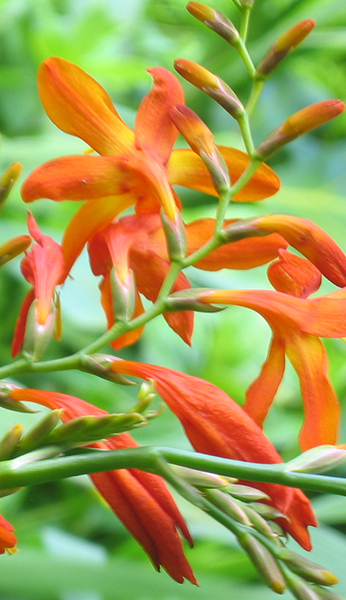
Montbretia is a vigorous and spreading perennial that was created by crossing Crocosmia aurea with Crocosmia pottsii. Montbretia grows from bulblike corms that are about 1 in (2.5 cm) in diameter. New corms are continually produced on short underground stolons rapidly forming large and dense clumps of pale green straplike leaves 2-3 in (5-7.6 cm) long and 1-2 in (2.5-5 cm) wide. Montbretia graces the summer with showy red, orange or yellow funnel-shaped flowers on slender, arching, zigzag spikes. Each flower is about 2 in (5 cm) across and the nodding cluster can be several inches long. Montbretia dies back to the ground in winter only to regrow from its circular, flattened, corms in spring.
As cut flowers Montbretia will last two full weeks in a vase. Buds open one after another starting from the bottom and working up. The bottom-most flowers drop off tidily as they are spent. Taking the blooms for arrangements induces further blooming all summer, from July to first frost in autumn. If summer gets too droughty or if summer blooms are permitted to go to seed, it will die back sooner. Leaves should not be trimmed until they are definitely dying back.
(Floridata Plant Encyclopedia. 2004.)
As cut flowers Montbretia will last two full weeks in a vase. Buds open one after another starting from the bottom and working up. The bottom-most flowers drop off tidily as they are spent. Taking the blooms for arrangements induces further blooming all summer, from July to first frost in autumn. If summer gets too droughty or if summer blooms are permitted to go to seed, it will die back sooner. Leaves should not be trimmed until they are definitely dying back.
(Floridata Plant Encyclopedia. 2004.)
Both of the parent species, and all 7 species of Crocosmia are originally from South Africa where they grow in moist grasslands.
(Floridata Plant Encyclopedia. 2004.)
(Floridata Plant Encyclopedia. 2004.)
Montbretia is a hybrid of garden origin, first produced in France in the 1880's. Montbretia has escaped from gardens and become established in mild, damp areas in many parts of the world, especially Europe and eastern North America.
The ability of Crocosmia to self-seed has rendered it a troublesome invasive in some parts of the world, though the newest hybrids are not as apt to be problems. In temperate climate, this South African native is restrained.
(Floridata Plant Encyclopedia. 2004.)
The ability of Crocosmia to self-seed has rendered it a troublesome invasive in some parts of the world, though the newest hybrids are not as apt to be problems. In temperate climate, this South African native is restrained.
(Floridata Plant Encyclopedia. 2004.)
- 043121 - collected by Tim Flynn in 1983
- 061316 - collected by Lynwood Hume in 1986
- 030630 - collected by Hank Oppenheimer in 2000
- 030629 - collected by Hank Oppenheimer in 2000
- 086714 - collected by Kelsey Brock in 2016
- S078705 - collected by Kelsey Brock in 2016
We currently have 6 herbarium specimens for Crocosmia ×crocosmiiflora in our collection. Click on any specimen below to view the herbarium sheet data.