.svg)


By Dr. Tiffany Knight, Director of Science and Conservation
In the Garden’s Juliet Rice Wichman Botanical Research Center, plant conservation happens every day. Our Science and Conservation team combines field expertise, seed banking, herbarium research, propagation, and restoration to bring some of the world’s rarest plants back from the brink. These are stories that span decades, linking past and present: a seed collected long ago, a plant rediscovered after presumed extinction, a species hiding in plain sight.
Each is the result of collaboration, deep knowledge, and unwavering commitment — and each underscores why sustained investment in plant conservation is essential. Without the science, facilities, and people, these plant stories could have ended very differently. Thanks to supporters like you, we can act when the moment is right, ensuring endangered species not only endure, but flourish in their home ecosystems.
I invite you to explore the stories of four extraordinary plants that have a brighter future because of the work supporters like you make possible.
From seed vault to valley, hāhā’s return shows what’s possible when foresight meets persistence.
Perched on slender stalks, hāhā’s (Delissea rhytidosperma) small rosettes of leaves create an elegant crown beneath which hang clusters of tubular flowers. Like many Hawaiian lobeliads, these flowers fit the curvature of Hawaiian honeycreeper beaks like a glove. And like many Hawaiian lobeliads, hāhā’s story is one of both loss and hope. Once, hāhā grew more freely across Kauaʻi’s valleys and ridges. But over time, grazing animals, invasive plants, hurricanes, and other pressures pushed hāhā to the brink of extinction. In 1977, NTBG president emeritus and Trustee Chipper Wichman collected hāhā seeds from Limahuli Valley. By 2015, research biologist Ken Wood documented hāhā as extinct in the wild — a sobering moment. Yet, because of those earlier collections and the persistence of NTBG’s field and seed bank teams, the species was not lost.
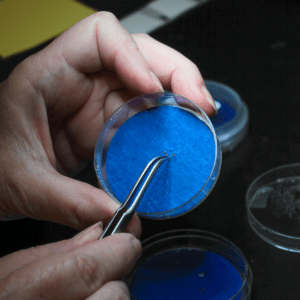
Today, nearly 200,000 hāhā seeds, representing 77 unique accessions from different plants and populations, are safeguarded in NTBG’s Conservation Seed Bank. This living archive has become the foundation for restoring the species to its home. From these seeds, over 100 plants now thrive in our nursery, and more than 300 have been carefully reintroduced to Limahuli Valley, where they once again take their place in the native ecosystem.
Hāhā (Delissea rhytidosperma) in NTBG nursery. Photo by Seana Walsh.
The seed bank’s role has gone beyond preservation — it has become a source of knowledge. Research has revealed that hāhā seeds remain viable for at least 18 years, far longer than initially thought. They germinate best at day and night temperatures of 77/59°F (25/15 °C), and current studies are exploring how ice crystallization temperatures influence their storage behavior and longevity. Each discovery adds to a growing body of knowledge that can guide conservation for hāhā and other rare Hawaiian plants.
Describing a new kāmakahala species opens the door to its recovery.
NTBG recently described a new species of kāmakahala, Geniostoma imadae. Kāmakahala represent an extraordinary example of adaptive radiation in Hawaiʻi, with most species found nowhere else in the world. Many are single-island endemics, each adapted to its own unique ridges, valleys, and microclimates. Among Hawaiʻi’s many threatened native plants, they are among the most imperiled with habitat loss, invasive species, and small population sizes placing the majority of kāmakahala on the federal endangered species list.
Geniostoma imadae is one of the newest members of this lineage to be formally described. Known from windward ridges and valleys on Kauaʻi, it had been collected but remained unnamed for years. Without a formal scientific description, it risked slipping through the cracks of conservation attention. That changed thanks to our herbarium — a collection of more than 96,000 preserved plant specimens documenting over 60 years of botanical exploration across Hawai‘i and the greater Pacific. Careful study of herbarium material allowed taxonomists to recognize Geniostoma imadae as a distinct species, giving it an official name and opening the door to its protection.
Kāmakahala (Geniostoma imadae). Photo by Ken Wood
Once we have propagated wild collected seeds, we will outplant them in our gardens. With plants thriving in our conservation collections, we can then move to restore this species in natural habitats. The story of this kāmakahala is a reminder that recognition is often the first step toward recovery, highlighting the critical role of herbaria, where the preserved past becomes the foundation for a species’ future.
From library shelves to living collections, Fautea’s story bridges knowledge and action.
Fautea (Lebronnecia kokioides) is a rare pink-flowering tree found only on a handful of islands in the Marquesas. This striking hibiscus relative produces red-haired, fuzzy seeds — belying its familial connections with cotton. Fewer than one thousand mature individuals remain, scattered across seven small subpopulations that continue to decline due to habitat loss, invasive species, and grazing by feral cattle and goats. Without focused conservation action, this species faces an uncertain future.
A turning point came through NTBG’s library and archives. Home to more than 20,000 volumes — including rare botanical prints, original artwork, field notes, and the Flora of the Marquesas — these resources preserve generations of knowledge that guide present-day action. Using the flora, NTBG botanists identified fautea as a priority for conservation and mapped its known range, setting the stage for an ambitious new effort to secure its survival.
Fautea (Lebronnecia kokioides. Photo by Ken Wood
With support from the Mohamed bin Zayed Species Conservation Fund, NTBG will conduct targeted surveys on Hiva Oa and Mohotani islands to collect seeds from as many individuals as possible and establish genetically diverse ex situ collections. Seeds will be propagated in NTBG’s nursery on Kauaʻi, safeguarded in our seed bank, and shared with partners in French Polynesia. These living and stored collections will serve as a genetic safety net for the species, supporting both research and future restoration efforts.
Rare Asplenium ferns unfurl in Victorian pages and living landscapes
In NTBG’s Sam and Mary Cooke Rare Book Room, among shelves of botanical treasures, lies a quiet record of Hawaiʻi’s mid-19th century plant life — an album of Hawaiian ferns compiled by William Hillebrand. A German physician who arrived in the Hawaiian Islands in 1850, Hillebrand served as royal physician and lead doctor at Queen’s Hospital, while also building the first formal flora of the Hawaiian Islands, published in 1888. His fern album, acquired in 1998 as part of the Loy McCandless Marks Botanical Library, contains pressed specimens — a Victorian-era keepsake format. Between its pages are common ferns and also rarities, offering a unique snapshot of the species present more than 150 years ago.
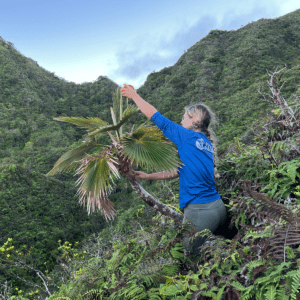
Among its most remarkable entries are two Diellia ferns — now recognized as part of the genus Asplenium: Asplenium dielmannii and Asplenium dielerectum. When NTBG’s herbarium began in 1971, both were believed extinct. Decades later, they were rediscovered in the wild, each with fewer than 50 known individuals. Federally listed as endangered and designated as PEPP (Plant Extinction Prevention Program) species, these ferns now benefit from protective exclosures, active habitat restoration, and close monitoring. In partnership with PEPP, NTBG has grown and outplanted more than 1,200 of these ferns into nearly half a dozen restoration areas. Many more gametophytes1 and mature plants are safeguarded in our fern lab and nursery.
Other rare and curious finds in Hillebrand’s album include Asplenium varians, known only from 19th-century collections; Ctenitis squamigera, an endangered fern possibly extinct on Kauaʻi; and an 1800s specimen of Selaginella kraussiana, decades earlier than its first official record for Hawaiʻi. Together, these pages are a bridge between the botanical past and the conservation present, reminding us how historical records can shape and inspire the work of protecting Hawaiʻi’s most imperiled flora.
Closing the Circle
These plants have been pulled back from the edge of extinction and preserved through the expertise, commitment, and long-term vision of NTBG. This work is resource-intensive, requiring specialized equipment, decades of field knowledge, and the capacity to act when opportunity strikes. Continued investment in plant conservation ensures we can keep collecting, storing, studying, propagating, and reintroducing species before it’s too late. The science we do today determines the living landscapes of tomorrow — and with support, we can write more stories like these.
[1] Early life stage of a fern