.svg)


By Jon Letman, Bulletin Editor
Dedicated to perpetuating tropical plants, ecosystems, and cultural heritage, NTBG’s staff face a long list of challenges — everything from battling invasive species and noxious weeds to working in hot, humid, and muddy conditions to collect, monitor, and grow some of the world’s rarest plants. Field botanists endure working on steep cliffs and teeth chattering cold nights in tents, maintenance crews are forever repairing equipment and fixing irrigation lines, while administrative staff juggle spreadsheets and schedules, balance budgets, and ensure the Garden’s broad range of programs and priorities are well-organized and efficiently executed.
Neither drought nor rain nor thorny underbrush stays Garden staff from their commitment to the Garden’s appointed mission. But today there is a new challenge — how to most effectively pursue scientific research, biocultural conservation, and environmental education in a time of change and uncertainty.
Kahanu Garden and Preserve. Photo by Mike Opgenorth
As the funding and support for science and environmental protection sees a significant shift, NTBG is redoubling our commitment to our work. Today the world faces multiple environmental threats from climate change and the loss of biodiversity to new pressures on public lands and irreplaceable wild habitat.
Navigating uncertainty
NTBG, established by a congressional charter in 19641, has always been a non-governmental not-for-profit organization. While NTBG is less dependent on federal funding than many of our peers, we are not immune to the loss of grants that offer budget relief and cover staff time, particularly for science and conservation programs. “The loss of future funding will be impactful to our organization,” says NTBG’s chief financial officer Tami Rollins.
As of September 2025, NTBG was partially supported by active grants from the National Science Foundation, the U.S. Fish and Wildlife Service, the National Oceanic and Atmospheric Administration, as well as the State of Hawai‘i’s Department of Land and Natural Resources, and Florida Department of State.
Science and Conservation director Dr. Tiffany Knight says that on one hand NTBG is in a relatively strong position thanks to the foresight of the Garden’s founders who created an endowment which reduces reliance on federal funding and provides stability. However, the current restriction of grants reduces our ability to pursue time-sensitive ambitious strategic goals.
Tiffany says there are so many conservation challenges urgently in need of being addressed which NTBG is uniquely poised to do. She says there is a limited window open now when NTBG could be making advances in preventing plant extinction. NTBG is equipped with new conservation tools and technical knowledge that would allow us to increase the collection of rare and declining wild plant populations that still hold invaluable genetic diversity, but she says this situation will not continue indefinitely.
“The time is now. We need to act now, and we don’t have the capacity to act like we should and neither do our partners,” Tiffany says.
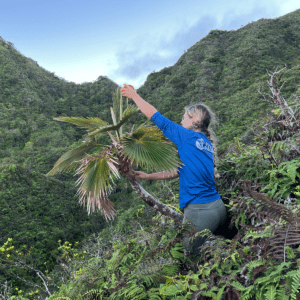
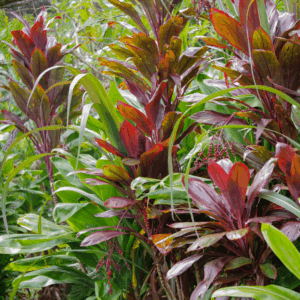
Left: Photo by Ken Wood. Right: Photo by Ben Nyberg.
The loss of grant support can translate into missed opportunities and stymied scientific progress. For example, under the U.S. Department of Agriculture, the Natural Resources Conservation Service (NRCS), awarded NTBG a grant of more than $85,000 in 2020 to develop innovative ways to revegetate difficult to access cliff habitat using drones and other new technology. That work had to be scaled back and delayed for years, first because of the Covid pandemic and then the FAA backlog to approve the drone license.
Ultimately, NTBG learned that the funds would not be released because the project’s description included the phrase “climate change.” As a result, the work has stopped (temporarily, we hope) as we try to find a solution.
Previously, Institute of Museum and Library Services (IMLS) grants have supported NTBG conservation of native Hawaiian plants, the digitization of herbarium collections, and other important projects. Earlier this year, the future of IMLS looked uncertain, but as of September, both the Senate and the House of Representatives have drafted funding bills with budget cuts far less extreme than originally proposed, possibly the result of pressure from advocacy groups.
Strength in solidarity
Individually, the loss of a relatively modest grant of ten or twenty thousand dollars may appear to be of limited impact, but over time, as the number and size of grants multiplies, the cumulative effects could be debilitating. Today, strategic planning and flexibility are just as important as during an economic recession or global pandemic.
We remain committed to funding essential infrastructure projects that will make our buildings and facilities more energy-efficient and environmentally sound. At the same time, NTBG continues to advance mission-driven science, conservation, and education programs.
As we look to the near future, NTBG needs to consider how to cover the cost of priorities and critical projects. Diversified funding, including memberships, private donors, public tours, and the generosity of Trustees and Fellows have all been a source of stability, vital threads in the fabric of NTBG support.
NTBG’s director of philanthropy, Natalie King, says that while the Garden is affected by funding cuts, we are also trying to be a good collaborator in advocating not only for ourselves but also our peers. She has been encouraged by the outpouring of concern by supporters. “They’re very conscious of how this impacts people,” Natalie says. “We’re being asked, ‘is your staff ok?’” She says it’s a powerful testament to the strength and commitment to NTBG’s mission “because we’re about connecting plants and people.”
The importance of scientific knowledge and expertise cannot be overstated, Natalie says, adding that NTBG’s decades of institutional knowledge is our powerhouse. “We want to help sustain and preserve expertise and knowledge because that’s what carries us through.”
Playing a positive role
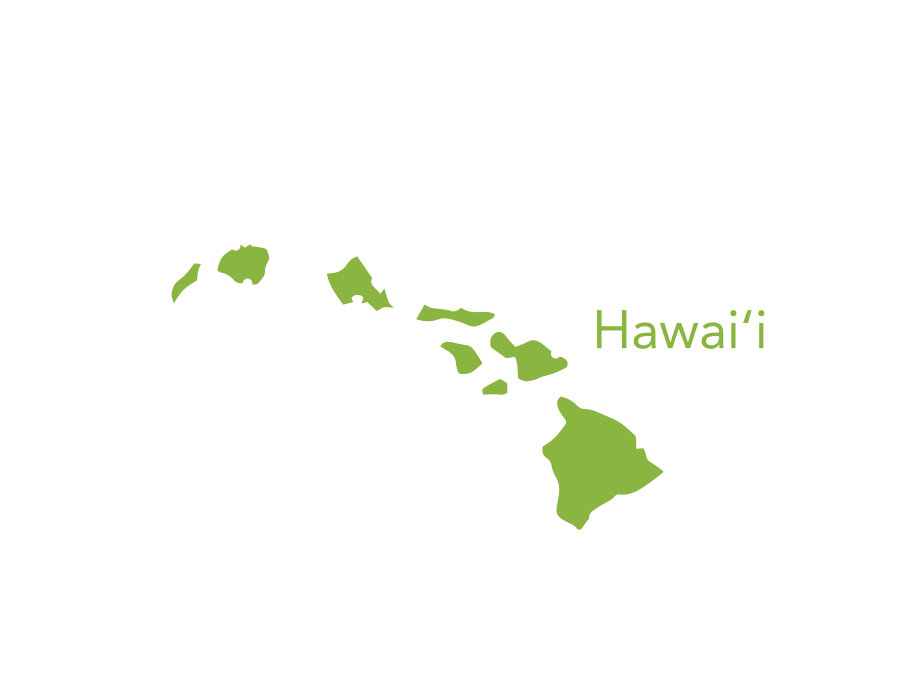
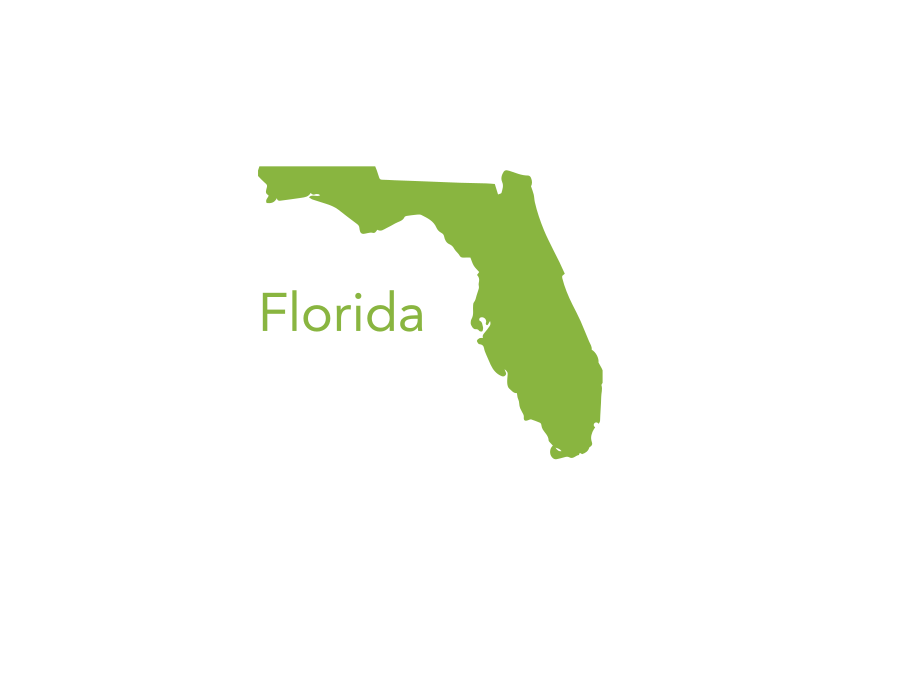
NTBG is unique in that we are a tropical botanical garden in the United States spread between two Hawaiian Islands and Miami, Florida. With a focus on rare and endangered species, many of which are narrowly endemic, we have established impactful programs like the Breadfruit Institute and a suite of environmental education offerings. NTBG’s botanical research center, seed bank and laboratory, herbarium, and other resources, along with important cultural, archaeological, and historical sites, stand out as conduits for biocultural conservation and community involvement.
Through NTBG’s many partnerships including with Florida International University at the International Center for Tropical Botany at The Kampong, along with our mentorship of students and interns, we are fostering the next generation of botanists and encouraging a host of other professional and academic pursuits.
The need for diversity
In the world of biological sciences, specifically botany, diversity is a fundamental quality of healthy populations and well-balanced ecosystems. For example, certain trees like koa and ‘ōhi‘a (Metrosideros spp.) need ferns and mosses in order to germinate. They struggle to reach maturity if they don’t have adequate ground moisture retained by companion plants. On remote islands, native plants which evolved in isolation may decline or become extinct if they are overgrown by more numerous but less diverse alien introductions.
Biological diversity makes our planet healthy, but today we face a biodiversity crisis. According to the International Union for Conservation of Nature (IUCN), nearly one-quarter of the world’s fish and freshwater animals face a high risk of extinction with migratory shorebirds, fungi, and other life forms from reef-forming corals and conifers to mammals, reptiles, and amphibians all facing elevated extinction rates. In 2024, the IUCN reported that 38% of the world’s tree species were at risk of extinction. Other studies highlight the large number of declining plant and animal species around the world.
NTBG is trying to stave off greater losses. Loulu (Pritchardia) palms, Hawaiian ferns, mosses and other bryophytes, as well as species-rich lobeliads are endemic to Hawai‘i. If they go extinct, diversity is diminished and our planet is impoverished.
Horticulture technician Fumi Waugh. Photo by Erica Taniguchi.
Committed to our cause
In the face of a rapidly changing environment, NTBG remains steadfast and committed to our work in Hawai‘i, Florida, and around the world.
For over 60 years, NTBG has been powered by people. Now, more than ever, we need you. Support comes in many forms, from financial contributions to volunteering, visiting our gardens, reading our stories and sharing our online posts, to telling a friend about something that the Garden has done that excites you or fills you with hope.
NTBG is dedicated to preserving a healthy planet where nature is revered, curiosity is valued, and knowledge is treasured. Preserving plants for future generations is a worthy pursuit, and something we can do when we work together, to create a world with botanical gardens and places where people and plants can flourish together.
[1] Established as the Pacific Tropical Botanical Garden, the Garden became National Tropical Botanical Garden in 1988