.svg)


By Jon Letman
Thanks to our community of staff, supporters, and partners, 2025 was a year filled with important plant wins. With each new discovery, initiative, and innovation, we are growing a brighter future for plants and people together.
Returning Ferns to Maui
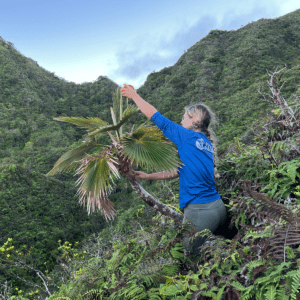
This autumn NTBG’s horticulture team, science and conservation staff, and outside collaborators returned more than 300 ferns representing seven native species to multiple locations on Maui. Those ferns were collected in 2022 as spores by Kahanu Garden and Preserve director Dr. Mike Opgenorth, NTBG postdoctoral researcher Dr. Susan Fawcett, and conservation partners.
With no dedicated fern laboratory on Maui, the spores were brought to NTBG’s fern lab on Kaua‘i where they were propagated and cared for until this fall. Once they were mature enough to be relocated, NTBG staff returned the ferns to Maui for outplanting. Often overlooked, ferns are one of the most important plant groups in Hawaiian forests and watersheds and the windward slopes of Maui’s Halekalā volcano are home to some of Hawai‘i’ richest and most intact forests with exceptional fern diversity. This successful end to a multi-year effort to collect, propagate, study, and return ferns to Maui is a significant plant win for 2025.
Publishing species new to science
In 2025, NTBG scientists and partners published a description of Lysimachia barcae, a newly discovered shrub in the primrose family known only from the wet forests of Kaua‘i. With just ten mature plants found on the north shore, the discovery and publication of this Critically Endangered species illustrates the importance of collaborative conservation fieldwork. The species name barcae honors its discoverer Nicolai Barca of The Nature Conservancy of Hawai‘i and his dedication to protecting Kaua‘i’s forests of Kaua‘i. The Hawaiian Islands are home to 16 species of Lysimachia, 14 of which are endemic to Hawai‘i. The island of Kaua‘i has the greatest diversity of Lysimachia — ten species (of which eight are found only on Kaua‘i).
This year NTBG and our partners also published a description of Geniostoma imadae, a small tree endemic to Kaua‘i. This member of the Loganiaceae family, while rare, may still have up to 1,200 individuals remaining in the wild. It was named for Clyde Imada, a research specialist at Bishop Museum in Honolulu. Closely related species of Geniostoma are known in Hawaiian as kāmakahala.
Meanwhile, a third native species of ‘ala‘ala‘wai nui (Peperomia sp. nov.) is in the process of being described for publication. These publications are a valuable reminder that there are many plants still unknown to science, and there remains much work to be done.
Defying extinction
Although Hawai‘i is often called “the extinction capital of the world,” NTBG hopes to change that. Through our ongoing efforts, we are reducing the number of species at risk of extinction. Equipped with the cutting-edge technology and dedicated partners, NTBG’s decades of experience and expertise are allowing us to make important progress to preserve biodiversity. NTBG’s director of science and conservation Dr. Tiffany Knight says that with hundreds of plant species in Hawai‘i facing a growing number of threats, the time to act is now because extinction is not inevitable.
One species NTBG is helping preserve is nānū (Gardenia remyi) which is known only from the islands of Kaua‘i, Maui, Moloka‘i, and Hawai‘i. Today there are as few as 70-80 individual plants left in the wild. But not all endangered plants are this rare and many have populations with hundreds or even thousands of individuals. This means we still have the opportunity to collect seeds to preserve genetic diversity, increasing the lucklihood of successful conservation.
Another species, Isodendrion pyrifolium, a member of the violet family, was thought to have fewer than 50 individuals left in the wild but in 2025, NTBG found three new populations in remote cliff habitats totaling over 100 individuals. Recently, we were able to collect seeds from these plants for the first time.
Also this year, and endemic Kaua‘i hāha (Cyanea kolekoleensis), a species that was thought to be extinct for over 30 years, was rediscovered by Hawai‘i’s Plant Extinction Prevention Program and NTBG staff in August 2024. Several thousand seeds were collected in 2024 and 2025. Using a combination of survey methods (ground, drone, and helicopter), a total of five individual plants are now known, and additional conservation work is underway.
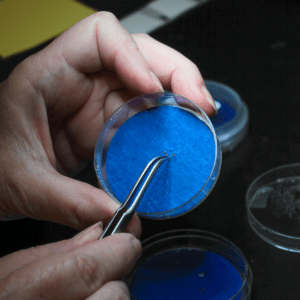
This year NTBG has also made notable progress in pollen and seed banking, working with seeds of hāha (Cyanea kuhihewa), ko‘oloa‘ula (Abutilon menziesii), and other rare species. We added significant numbers of seeds collected from species previously not represented or underrepresented in our seed bank. Staff also improved our understanding of the foundational biology necessary to conserve the pollen of nānū (Gardenia brighamii), hōlei (Ochrosia kauaiensis), and lama (Diospyros sandwicensis).
“We have the tools, we have the expertise, and many of the threatened species can still be added to conservation collections,” says Tiffany Knight. “We can’t let these species go extinct because they are masterpieces of evolution and part of our cultural heritage.”
Over 5,000 plants adopted through Grow Aloha
Grow Aloha is more than a monthly plant adoption program — it is a movement toward community-driven, biocultural restoration. Since launching in March 2024, the program has empowered over 3,300 residents across 150 zip codes to deepen their relationship with the plants intrinsic to Hawaiian ecosystems and culture. By distributing more than 5,000 plants representing 120+ native and heritage species, NTBG and our statewide partners are equipping people to sustain biodiversity and nurture communities in their own homes and growing spaces. We are honored to partner with Molokaʻi Land Trust, Bishop Museum, Maui Nui Botanical Gardens, and Amy Greenwell Ethnobotanical Garden to “grow aloha” across Hawaiʻi.
Find the next adoption near you at www.growaloha.org.
Delivering the goods
At NTBG’s Conservation and Horticulture Center on Kaua‘i, key nursery functions include propagating plants for conservation, long-term ex situ storage, producing seeds for our seed bank, and providing cuttings and plants for restoration and outplanting in NTBG gardens and elsewhere.
In 2025, NTBG delivered at least 250 individual plants to our conservation partners. These included Gardenia remyi, Cyanea kuhihewa, and Plantago princeps var. anomala. This year, NTBG delivered nine Plantago plants to our partners at Hawai‘i’s Division of Forestry and Wildlife. These plants were first collected by drone and Mamba collecting arm in 2022, then propagated by our nursery manager in 2023.
Prioritizing Palm Conservation
With roughly 2,600 species, the diversity of the palm family (Arecaceae) makes it one of the most important elements of the tropical world. The United States alone is home to some 35 native palm species (two-thirds of which are native to Hawai‘i), giving NTBG an important role to play in palm conservation. Hawai‘i’s only native palm genus Pritchardia (called loulu in Hawaiian) has 23 recognized species of great ecological and cultural significance.
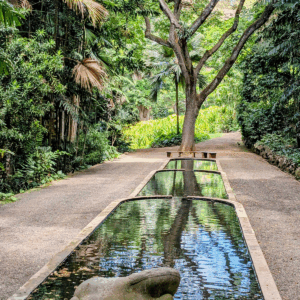
Because of the growing number of threats facing palms, in 2025, NTBG made the decision to prioritize the collection, study, and conservation of palms which make up an important part of our living collections. All five NTBG gardens have palms, the largest number — more than 700 loulu palms and other species)— in McBryde Garden. In total, around 277 palm species are represented in our living collections, placing NTBG among the top ten botanical gardens globally for palm diversity.
In 2025, we continued to safeguard our collections against the coconut rhinoceros beetle (CRB), an introduced pest first detected in Hawai‘i in 2013 that is devastating coconut palms and other plants across Hawai‘i. Because CRB poses a grave threat to loulu palms, in 2025 our horticulture team and volunteers dedicated the equivalent of an estimated 487 days of labor in an effort detect and prevent the spread of this pest. Efforts include managing mulch piles, monitoring, netting, and treating palms with contact or injected insecticide and periodic drone applications for palms too tall to reach otherwise.
Unfortunately, there is no known way to completely prevent the spread of CRB and so we remain vigilant. Also, because most palm seeds cannot be dried, frozen, or stored in a seed bank, maintaining an ex situ (off site) conservation collection in a managed setting is essential. The good news is that our efforts are paying off and to date we may have lost only one tree to CRB. You can read more about NTBG’s loulu conservation and battle against CRB here.
Breadfruit duplication and distribution
In the more than two decades since it was established, NTBG’s Breadfruit Institute has become a global knowledge hub for breadfruit-related education, research, and conservation. In managing the world’s largest and most diverse collection of breadfruit varieties (150 cultivars from 34 islands), Breadfruit Institute staff are constantly monitoring trees as they mature and age. In 2025, we increased our efforts to identify at-risk varieties, taking steps to ensure the longevity, health, and vigor of our collection.
Duplicating older or at-risk trees is one effective way to maintain the collection and particularly important for varieties which exist in only small numbers in their home islands or our collection. In 2025, taking advantage of our staff expertise in air layering and stem cutting propagation, we successfully duplicated 21 out of 25 breadfruit varieties identified as at-risk.
Through our public outreach efforts, we recognize the high demand and enthusiasm for the seedless, dense, nutrient-rich Hawaiian ‘Ulu variety of breadfruit. On Maui, breadfruit collection manager Kaitu Erasito has been air layering verified Hawaiian ‘Ulu varieties, creating new opportunities to bring this variety to more people in the community. The air layering process requires more time than tissue culture used to produce Ma’afala and Ulu Fiti varieties but still represented roughly 15-20% of our breadfruit distribution in 2025.
Also, this year, under the direction of Breadfruit Institute program manager Noel Dickinson, we continued to develop a practical, reliable framework for assessing, monitoring, and managing large breadfruit collections. The goal is to develop a collaborative system that can be applied to any breadfruit collection, ensuring adaptability, careful documentation, and conservation value.
Fostering people and plants together
In 2025, NTBG offered a diversity of educational opportunities in all five gardens, serving K-12, undergraduate and postgraduate students, as well as science educators, journalists, community members, and others.
Continuing our legacy Internship Program, NTBG hosted five interns this fall who gained experience in our four Hawai‘i gardens by preparing planting areas, nursery management, project planning, and more.
In July, students (grades 3 to 8) joined our ‘Ike Māla summer program in Allerton Garden and McBryde Garden. At Limahuli Garden, through last summer, we provided educational opportunities to more than 1,900 learners including school groups, community events, and cultural programs like our Lā‘au Lapa‘au traditional medicine tour. With the opening of the Limahuli’s 2,400 sq. foot Limaola Cultural Arts facility, biocultural education has a welcoming new venue.
In Florida, staff collaborated with the International Center for Tropical Botany at The Kampong to offer a summer research and training program, bringing together Miami-area high school students, scientists, and educators. Students collected data, designed experiments, and developed their knowledge and enthusiasm for studying environmental and plant-related science. The Plants and Climate Change Education program provided technical skills and real-world experience through the study of plant science and plant-animal interactions.
These “Plant Wins of 2025” were made possible with the generous support of people like you. Help us grow a brighter tomorrow for tropical plants through a donation today.