.svg)


By Jon Letman
Botanical artist Wendy Hollender has had her eye on plants for a long time, marking the individual qualities and characteristics that make them beautiful and beloved. One fine spring day, while standing in a patch of ramp (wild garlic) near her son’s farm in New York’s Hudson Valley, inspiration struck. She had just read an article about alliums (garlic and onions) when it occurred to her to do one large illustration focused on a single family of plants.
“I’ve drawn a lot of these plants separately, but what would it feel like to let them meet each other, on one page and relate to each other?” pondered Wendy. Standing in that patch of ramps, she decided she would start with the alliums. After Wendy completed her first plant family portrait, she quickly drew three more… the mustard and citrus families and Solanaceae (tomato, eggplant). Once she had completed four families, she thought, why not do twelve, and if she was going to do twelve, why not twenty-four? That, she said, would make a book.
After five years of research and drawing, those works have been assembled in Wendy’s latest book, The Album of Plant Families: An Illustrated Exploration of Nature’s Beauty and Bounty. Measuring 12 x 16 inches, it’s a large art book but not so big or heavy that it’s difficult to hold.
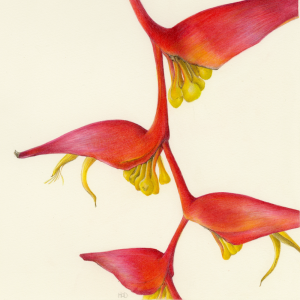
Wendy says she “worked like crazy, night and day” to complete the book. “I was a maniac,” she admits. Each portrait was rendered using color pencils, watercolors, and pens with inspiration and guidance from her subjects.
“The plants were my partners,” Wendy says. “They helped me all along the way.”
The book features twenty-four portraits of well-known plant families (grasses, palms, citrus, mints, etc.) with detailed explanations of how and why she chose the families she did. The book includes fifteen guest essays by botanists, artists, and others including the National Tropical Botanical Garden (NTBG)’s senior research botanist Dr. David Lorence and Lei Wann, director of Limahuli Garden and Preserve on Kaua‘i who wrote about the traditional uses of plants in the ginger family based on her own family knowledge. Dr. Michael Balick, a botanist at The New York Botanical Garden, shared an essay on the ethnobotany of palms in the neotropics.
The Album of Plant Families includes an illustrated diagram showing select plant families by size (Orchid family 28,000+ species, Coffee family 14,000+) with a reader-friendly explanation of why a plant family includes the members it does. But you don’t need to be a botanist or even have a green thumb to appreciate the book.
Wendy says this collection is for everyone. “If you’re a grower, a forager, a gardener, an admirer of botanical art, or if you love plants or even if you know nothing about them, or if you like to eat plants, or if you’re a family wanting to help your children understand plants, where they come from, and what they look like… this book is for you.”
And even as artificial intelligence seems to be creeping into every corner of our lives, Wendy says she feels great about her hand-drawn illustrations because “you would never want to do this with AI and lose out on the experience of studying and drawing the plants up close.”
Collaborating with her publisher and a design team, Wendy’s aim was to produce a book that wasn’t overly technical or too scientific but had the intellectual backbone that would make it informative for both beginners and avid plant enthusiasts.
Many of the illustrations were done at NTBG on Kaua‘i where Wendy has been teaching an annual botanical illustration workshop since 2007. Other drawings were done at her home studio or her son’s vegetable farm in the Hudson Valley. When she could, she traveled to the plants to draw them (breadfruit and vanilla in Hawai‘i and Florida, mulberries in New York, figs and peas in Spain). She also spent several weeks drawing at New York Botanical Garden.
The book is not only the story of plant families but of the people who grow and care for those plants. “The stories that I tell are very personal,” says Wendy.
Wendy explains how plants in the same family are sometimes so utterly different from other family members until you study the tiny flowers under magnification and notice similarities. She focuses on a mix of tropical and temperate plants that are valued and beloved by humans for their fruits, flowers, and fragrances.
“That’s how I chose my plant families — the ones we use a lot, whether it’s for food, medicine, or beauty.” She also worked with a mycologist to include mushrooms (technically not plants), but she wanted to include them.
While the plant families will be familiar to most people, she says each chapter is full of surprises. For example, the rose family includes strawberries, peaches, pears, plums, and raspberries. “Did you know that?” Wendy asks.
The original paintings from the book will be displayed at an exhibition in Kingston, New York in July. Wendy will also be doing in-person and online talks and workshops at Longwood Garden, Delaware Museum of Nature and Science, and the Harvard Museum of Natural History alongside the Blaschka glass flowers collection.
The Album of Plant Families will be available from May 26 and can be pre-ordered (signed copy) at: https://drawbotanical.com/product/plant-families-book-preorder-signed/