.svg)
Category: Limahuli
NTBG Environmental Journalism Program accepting applications for 2024
Offered on Kauai, May 12-18, 2024
The Hawaii-based National Tropical Botanical Garden (NTBG) is accepting applications for its Environmental Journalism Program offered May 12–18, 2024. Designed for professional journalists (staff or freelance) working in broadcast, print, online, and other media, the immersive program provides a background in tropical botany, ecology, and biocultural conservation with a progressive approach that honors Indigenous legacies and integrates cultural values. The program is structured to enhance well-informed, accurate reporting on environmental issues with a focus on tropical and island systems and the importance of plant science, conservation, and biodiversity.
The Environmental Journalism (EJ) Program is offered at NTBG headquarters, in three of its five botanical garden sites, and other locations on the island of Kauai. Established in 1964 by a Congressional Charter, NTBG encompasses ancient Hawaiian cultural and archaeological sites, extensive botanical living collections, a LEED-certified botanical research center, a botanical library and rare book collection, a seed bank and laboratory, a historical garden estate, a horticulture and conservation center, and other natural and man-made resources and facilities.
NTBG provides richly varied indoor and outdoor living classroom settings in which to study and experience new and traditional ideas while exploring critical concepts of biology, ethnobotany, biocultural conservation, habitat restoration, seed banking, agroforestry, and herbaria specializing in tropical and sub-tropical flora.
EJ Program presenters include NTBG staff and non-staff scientists, educators, and experts in botany, horticulture, taxonomy, field biology, ornithology, ethnobotany, and other related fields.
Participating journalists can expect to gain a greater understanding of important elements and current developments that will assist them in reporting on science and the environment. The goal of NTBG’s EJ Program is to introduce critical information and concepts in order to foster a greater understanding of these issues. The EJ Program is not expressly intended to provide source material for prospective news stories, although NTBG staff and other speakers may be available for interviews outside program hours.
NTBG provides all participants free on-site shared housing, airport transfer, and ground transportation. EJ Program participants are responsible for the cost of their own airfare to Lihue Airport on Kauai, meals, incidentals, and any additional expenses such as U.S. visas, etc.
Apply starting: Thursday, February 1, 2024 (6 a.m. U.S. Eastern Standard Time)
Deadline to apply: Wednesday, February 21, 2024 (5:00 p.m. U.S. Eastern Standard Time)
Notice of acceptance by: Tuesday, March 5, 2024
Dates of program: Sunday, May 12 – Saturday, May 18, 2024
*All participants will check into NTBG housing on Sun. May 12 and check out on Sat. May 18th
Required to Apply: Complete Environmental Journalism Program online application and provide two samples of recent work in print, audio, video, or online reporting (URL links only please). Submission of a CV/resume is optional.
APPLY AT: https://ntbg.wufoo.com/forms/environmental-journalism-program/
Website: https://ntbg.org/education/professional
Email: education@ntbg.org
An Eye on Plants – Koʻokoʻolau (Bidens wailele)
By Jon Letman, Bulletin Editor
The Hawaiian flora is comprised of a remarkable variety of rare flowering plants, many of which grow nowhere else. But the islands are also home to one of the most prolific plant families, Asteraceae, which includes chrysanthemums, daisies, and sunflowers.
Among the approximately 25,000 Asteraceae species worldwide is the genus Bidens which has between 150 and 235 species, with 42 in Polynesia alone. Called koʻokoʻolau in Hawaiian, Bidens is considered a prime example of adaptive radiation in Hawaiʻi. The genus has been found on seven of the eight high Hawaiian Islands and probably once grew on Niʻihau. The islands claim 19 endemic species, seven of which occur on Kauaʻi, three of them single-island endemics. Bidens are highly variable in form, growing in habitats ranging from coastal dunes, lava flows, and cliff faces to scrubland, bogs, and forests over 2,000 meters high.
In 2020, when University of Hawaiʻi-Hilo botany professor Matthew Knope returned to his family home on Kauaʻi during the pandemic, he and NTBG research biologist Ken Wood agreed the time was right to collaborate on describing a highly unusual Bidens limited to remote parts of Kauaʻi’s rain-soaked interior. The Bidens in question had been found growing in small populations near the rim’s edge of the Blue Hole crater and in scattered talus along the base of cliffs below Mt. Waiʻaleʻale. An additional colony was located at the back of the Wainiha Valley, Kauaʻi’s deepest drainage. Both areas are known for thousand-foot-high cliffs and ribbon-like waterfalls.
Left: Bidens wailele colored pencil and watercolor illustration by Wendy Hollender. Right: Blue Hole crater. Photo by Steve Perlman.
Botanists have documented this rare Bidens for years, but its lineage was uncertain and additional fertile material was needed for its description. This new Bidens species caught the botanists’ attention with its low, spreading habit and very unusual inflorescence which had long stalks terminating with a nodding flower head, similar to the bird-pollinated Bidens cosmoides. This undescribed Bidens was considered most closely related to B. valida, a Kauaʻi endemic found in several remote mountain regions of southeastern Kauaʻi
Over multiple field trips, Matthew and Ken made herbarium vouchers and collected viable seeds which have since been grown at NTBG’s conservation nursery. Utilizing collections from various botanists over the years, Matthew and Ken proceeded with a taxonomic assessment, describing its distinctive morphology, habitat, and conservation status. The formal written description was submitted for peer review along with photos, maps, and an illustration by NTBG partner and botanical artist Wendy Hollender.
Over a period of nine months — relatively fast in the world of taxonomic publication — the new Bidens was described and accepted as a new species. Matthew and Ken gave it the name Bidens wailele (lit. “leaping waters”) in recognition of its habitat. In June, the paper was published in the International Journal of Plant Sciences in a special issue honoring the legacy of noted Asteraceae specialist Vicki A. Funk.
With an estimated 700-800 remaining individuals, B. wailele meets the criteria to be listed as Critically Endangered on the IUCN Red List of Threatened Species. According to Matthew, Bidens represents “one of the most rapid and explosive plant diversification events in the Pacific.” What contributes to this diversity and wide dispersal? Ken explains that the tiny barbs and bristly nature of the seeds easily stick to birds, making them more likely to be carried long distances. He adds that Bidens probably evolved alongside Hawaiʻi’s yellow-faced bees and various diptera (flies) which served as pollinators and the plants may have been a favorite food of the flightless geese and duck-like fowl that once lived in Hawaiʻi. Surely, the first humans to reach Hawaiʻi admired Bidens for its delicate green foliage and bright yellow flowers. Bidens muʻo (branch tips) have long been drunk as a medicinal tea, consumed to fight colds and promote general health. Indeed, other Bidens species are used medicinally around the world. Lei Wann, director of Limahuli Garden and Preserve, began drinking koʻokoʻolau tea as a child. She describes the taste as mildly sweet and earthy and says there are still families who visit the Limahuli Valley to gather Bidens, a plant that is both rare and yet familiar to many.
People need plants. Plants need you.
Plants nourish our ecosystems and communities in countless ways. When we care for plants, they continue caring for us. Help us grow a brighter tomorrow for tropical plants.
Biocultural Conservation at NTBG
Weaving hala leaves for a pāpale (hat). Photo by Shandelle Nakanelua
Defining our approach to restoring relationships between plants, people, and places.
At its heart, biocultural conservation recognizes the inseparable bonds between humanity and nature. Many Indigenous cultures share concepts of kinship across species, elements, and places. In Hawaiʻi, the idea of ʻohana (family) transcends humans. For example, kalo (taro) is the older brother of kānaka (Hawaiians). Native Hawaiian scientist Keolu Fox says, “when I say that the land is my ancestor, that is a scientific statement.”
Anishinaabe writer Patty Krawec shares the phrase “nii’kinaaganaa,” encapsulating the belief that “the world is alive with beings that are other than human, and we are all related with responsibilities to each other.”
Biocultural conservation accounts for these relationships, honoring the familial bonds that Indigenous communities maintain with biodiversity, integrating the life-sustaining, ecological knowledge cultivated over generations as they care for the land.
Left: Limahuli Garden Visitor Program Manager Lahela Chandler Correa. Right: Hale Hoʻonaʻauao (House-of-teaching) in McBryde Garden. Photos by Erica Taniguchi.
Secretary Deb Haaland, the first Native American U.S. secretary of interior, said, “Indigenous knowledge must be at the center of our conservation efforts, as we restore a cultural balance to the lands and waters that sustain us.” This call to action is echoed by the United Nations, the International Union for Conservation of Nature, and other partners.
Biocultural conservation integrates communities in collective stewardship and decision-making. It aims to protect not only plants and physical landscapes, but also cultural heritage, languages, practices, and social systems that are connected to the health of our shared environment. In biocultural conservation, our relationship with plants and places deeply matters. Perceiving the reciprocity of this relationship can lead to lasting, transformative change.
At NTBG our mission to perpetuate plants, tropical ecosystems, and cultural heritage is rooted in biocultural conservation. Below are six examples of what this concept means to our staff. Each has their own way of expressing biocultural conservation. As you read, we hope you’ll consider what plants mean to you and, conversely, what you mean to them.
—David Bryant, Director of Communications
Left: Science and Conservation Director Nina Rønsted. Photo by Jon Letman. Right: Hala (Pandanus) at Kahanu Garden. Photo by Seana Walsh.
On the global stage, biocultural conservation can be seen in international agreements such as the Kunming-Montreal Global Biodiversity Framework, signed by 188 countries in 2023. The framework’s vision is “living in harmony with nature where, by 2050, biodiversity is valued, conserved, restored and wisely used, maintaining ecosystem services, sustaining a healthy planet and delivering benefits essential for all people.”
This vision puts the relationships between people and nature at the center of solutions to ensure the best possible data, knowledge, and practices contribute to effective biocultural conservation.
To cite one example, in Colombia, dry forests are categorized as critically endangered ecosystems due to extensive clearing for cattle ranching and agriculture. To address this, a series of forest plots have been established in collaboration with local communities, that not only measure scientific biodiversity indicators, but also use community input to identify issues related to deforestation, biodiversity use, and valuation of ecosystem services. The hope is to find conservation solutions that satisfy both ecosystem protection and local societal needs.
In Canada and Aotearoa (New Zealand), negotiated settlements of Indigenous rights in fisheries management are creating sustainable marine biocultural conservation models based on Indigenous knowledge and long-term commitments to sustain resources and ecosystems. These offer an alternative to the polarizing all-or-nothing models of commercial fisheries vs. marine reserves.
There are countless other examples around the world that illustrate how, through a combination of local, national, and international legislation and initiatives, biocultural conservation honors the intrinsic relationships between nature and humanity.
Similarly, at NTBG, we are harnessing our experience and expertise to build conservation programs that align with cultural values and community priorities while enriching life through the perpetuation of tropical plants, ecosystems, and cultural heritage.
—Dr. Nina Rønsted, Director of Science and Conservation
Lei Wann, Director of Limahuli Garden and Preserve. Photo by Erica Taniguchi.
I see biocultural conservation as a way of expressing the intrinsic and scientific relationship between people, places, culture, and science. It’s a way of acknowledging that we practice science in its Western form, but there’s so much more to our work than that. At its core, these are deep connections and relationships with plants that have existed for generations.
Often what we find is that the ʻike (knowledge) we have of plants from our ancestors aligns with scientific research and findings. Biocultural conservation is the way we’ve come to express that science has such deep meaning here in Hawaiʻi because of the ʻike from our kupuna (elders) and the deep relationships we share with plants.
—Lei Wann, Director of Limahuli Garden and Preserve
Left: Brian Sidoti, Director of The Kampong. Photo by Alejandra Libertad. Right: Entryway at The Kampong.
NTBG’s only garden outside of Hawaiʻi, The Kampong, is in Miami, Florida. Our name, Kampong, can be translated as “village.” In this spirit, we use this space to honor the Indigenous communities that once lived here while celebrating the significance of our living collections to the rich tapestry of immigrant communities that make up Miami today.
At The Kampong, biocultural conservation is influenced by those who resided here before us. This includes Dr. Eleanor Galt Simmons, one of Dade County’s first licensed female physicians whose office and stable are on the grounds of The Kampong. From the 1890s, Dr. Simmons treated patients, making house calls by horse, buggy, and boat. Today we are planning a guided visitor experience that will interpret medicinal plants used by Dr. Simmons as well as by Native Miccosukee and Seminole peoples.
We also tell the story of plants collected by famed botanist Dr. David Fairchild who introduced thousands of edible and ornamental plants to the United States. David Fairchild named this site The Kampong in 1916.
Another key figure at The Kampong was Catherine “Kay” Hauberg Sweeney, an intrepid and impassioned plant collector who, with her husband, purchased this property in 1963. Mrs. Sweeney devoted her life to ensuring The Kampong remained a refuge for tropical plants and plant enthusiasts. The commitment of these early inhabitants laid the foundation for The Kampong today.
Looking ahead, we continue to add native plants to our collections. In collaboration with faculty of the International Center for Tropical Botany at The Kampong, our pursuit of plant research, public outreach, and education, is rooted in biocultural conservation. We remain focused on three themes: preserving tropical plant diversity; conservation and management of threatened tropical species and habitats; and fostering an understanding of tropical plant-based goods and services such as food, fuel, fiber, and medicine.
—Dr. Brian Sidoti, Director of The Kampong
Uma Nagendra, Limahuli Preserve Conservation Operations Manager. Photo by Erica Taniguchi
Central to biocultural conservation is human culture and our relationship to the natural world. This connection inherently expands our conservation practices, values, and priorities. Biocultural conservation provides us with more sources of knowledge and expands the range of people who are enthusiastic and invested in our work.
Biocultural conservation guides nearly all we do at Limahuli Garden and Preserve. But often overlooked are defining personal experiences. This is what it feels like to me: the shade of young kukui (Aleurites moluccana) saplings serving as nurse trees in newly cleared restoration areas. It feels like the stickiness of hau (Hibiscus tiliaceus) branches being stripped for cordage. I hear it in voices raised in oli (chants) at the beginning of each workday, and in the bird cries of uaʻu (Pterodroma sandwichensis) and aʻo (Puffinus newelli) barking in the Upper Limahuli Preserve.
Biocultural conservation tastes like refreshing ʻōhiʻa ʻai (Syzygium malaccense) fruits plucked from the tree and Tahitian prawns fished from the stream. It is the weight of kōpiko (Psychotria mariniana) branches and ʻalaheʻe (Psydrax odorata) collected for carving. Biocultural conservation maintains the ungulate fence, but also knows the names of the neighborhood hunters to call when you find a sign of pigs in the valley.
Biocultural conservation is not only theory; it is practice. It is action. It is listening, learning, striving, making mistakes, and trying again. Biocultural conservation is a lei formed from the interwoven strands of people, plants, and places which we are communally, perpetually weaving.
—Dr. Uma Nagendra, Conservation Operations Manager, Limahuli Preserve
Left: Mike Opgenorth, Kahanu Garden and Preserve Director. Photo by Shandelle Nakanelua. Right: Kahanu Garden.
At Kahanu Garden and Preserve, biocultural conservation teaches us the critical role humans play in the survival of native ecosystems. On the coast of East Maui, tradewinds deliver sheets of Hāna’s famous ua kea (white rain). Inside Kahanu Preserve’s hala (Pandanus tectorius) forest, the trees provide shelter beneath its canopy. There we can marvel at the tree’s fruit which resembles pineapples arching from the end of branches. The space evokes memories of the people who once used material from these trees to create thatched mats, hats, sails, and lei. Even the tree’s hīnano (male flower) was considered an aphrodisiac. Hala’s stilt-like roots also prevent erosion along the rocky cliffs where they grow.
Coastal hala forests, like those found in the Kahanu Preserve, have been dwindling across Hawaiʻi as a result of invasive species and habitat lost to agriculture and development. An introduced scale insect attacks hala, as is evident by the powdery shells sucking life from its leaves. Highly invasive African tulip trees emerge and spread over the hala canopy where they disperse thousands of seeds.
The future of hala forests like those found at Kahanu Preserve is uncertain, but cultural practitioners seeking fresh plant material have the opportunity to remove invasive plants, perpetuating their own practices while helping save young hala trees and contributing to the long-term health of the forest.
This is the interdependence of biocultural conservation at Kahanu Garden and Preserve. Without hala trees, cultural practices would almost certainly cease to exist. And without human stewards of the forest, the trees would also likely be lost. Through clearing invasive plants and supporting the growth of hala seedlings, we can perpetuate culture, preserve an ecosystem, and provide resources for future generations while protecting the island that protects us.
—Mike Opgenorth, Director of Kahanu Garden and Preserve
Mike DeMotta, Curator of Living Collections. Photo by Erica Taniguchi.
For me, an effective and meaningful biocultural conservation program at NTBG requires a full understanding of Hawaiian values, a Hawaiian world view, and my place in it. Kuleana (responsibility) and aloha ʻāina (love of the land) are values that guide my decision-making process.
The first Hawaiians understood that their actions needed to be sustainable so their relationship with the natural world could enhance biodiversity and ecosystem function. Prior to contact with the west, Hawaiians saw the importance of native ecosystem function as kinolau (physical manifestation) of the kini akua (pantheon of gods). All elements of nature — water, earth, the ocean — were kinolau of major deities.
Living with these sacred elements demanded thoughtful actions and deification required Hawaiians to respect and care for nature in a way that benefited people and ecosystems. This enabled Hawaiians to successfully settle in these islands and support a large population without the negative impacts so common today.
We can be guided by these principles, integrating them into the management of our gardens and preserves in a way that mitigates the harm caused by our modern lifestyle. By embracing biocultural conservation, we can acknowledge what we need to change and identify traditional practices that, if revived, can help maintain ecosystem function. A full understanding of how we fit into nature is essential in rebuilding natural systems that are abundant and resilient.
—Mike DeMotta, Curator of Living Collections
People need plants. Plants need you.
Plants nourish our ecosystems and communities in countless ways. When we care for plants, they continue caring for us. Help us grow a brighter tomorrow for tropical plants.
Reviving a Traditional Landscape in Limahuli Valley
Noah Kaʻaumoana, mālama ʻāina specialist, harvesting kalo in Limahuli Garden. Photo by Joshua Diem.
By Joshua Diem, Mālama ʻĀina Tech II
Here, in Limahuli Valley, the mountains rise above the clouds, as though tethered to earth by the roots and vines of a changing landscape, their black volcanic faces gazing out across the vast Pacific. Carved from basalt, the mountains stand as ancient warriors, abstract and muscular, as if shaped by a wild, surrealistic deity. Here, the pōhaku (stones) have names, stories, and characteristics as distinct as you or I.
As if chiseled by a sculptor, fallen stones populate the valley floor to form boulder fields. Rainwater from cloud forests — the wao akua[1] — feeds the stream below, braiding its way to the ocean, splitting the valley into east and west. To navigate the 600-acres of the Lower Limahuli Preserve, imagination is perhaps your most essential companion.
I began my work as a field technician in the preserve. Uncovering the valley’s rich history and enduring traditional practices propelled me towards my graduate studies in landscape architecture at Harvard University. What began as a series of inquisitive sketches of these ancient walls, evolved into three years of research for my design thesis. The objective was to uncover the archaeological framework of an indigenous agroecological system within Limahuli Valley, exploring how it can be revitalized and incorporated into broader restoration efforts. Doing so can exemplify a new standard of biocultural conservation. This project presents a vision for reinterpreting the valley’s legacy through its stonework.
The site of my research is the 2.8 acre ʻilipaʻa (agricultural homestead) built several centuries ago between the Limahuli Stream and the valley’s western wall. Standing below Mauna Hou and Maunapuluʻō peaks, the site includes over one hundred interconnected loʻi (flooded terraces) once used for irrigating kalo[2] (taro).
The primary house site, positioned at the compound’s midpoint, allowed its inhabitants to oversee water management and crop rotation. Assuming wetland crop yield was comparable to today, this agricultural system may have sustained a family unit of approximately 20-50 members. We are uncertain of the identity of the ʻohana (family) who once inhabited and nurtured the site or how they or their ancestors moved the stones. Whoever fed from this place, cared for the source of its wai (fresh water).
Aerial plan view of reconstructed ʻilipaʻa (agricultural homestead) in the Lower Limahuli Preserve. The stone complex includes home sites and terraced agriculture that follows the natural contouring of the landscape and drainage basins. The plan identifies loʻi (flooded terraces) and ʻauwai (irrigation waterways) most suitable for restoration based on field observations and collected data. Rendering by Joshua Diem
Today, overgrown neke fern[3] swamp hides the existence of the puna wai (fresh-water spring) that continues to seep from an opening in the valley wall. Channeled into the ʻauwai puhi (main irrigation ditch), gravity directs the flow of water, initially tracing its line along the base of the pali (cliff). The ditch crosses a small aqueduct-like structure and pools in a check dam. Finally, the water is distributed into the loʻi kalo. Top of FormBottom of FormWhen this landscape was actively cultivated, it must have evoked a profound sense of rhythm and connection.
This ʻilipaʻa was likely inhabited until the mid-19th century when its abrupt abandonment may have been the result of sweeping changes in property tax laws throughout the Hawaiian Kingdom. These policies reflected the broader social, political, and economic changes in Hawai‘i during that time and left the valley without its stewards.
Tapestry of ancient landscapes
Walking into the Limahuli Preserve is like traveling through time. Step off the trail and you risk getting lost in a dense tangle of vegetation. All but hidden to the unfamiliar eye, the landscape is a dynamic expression of the interplay between people and their environment with remains of the terraces, irrigation channels, and house sites. Garden plots that once flourished now lie overgrown and hard to recognize.
To recover these ruins, the site was surveyed and validated using GPS and Lidar instrumentation[4]. The collected data was then integrated into architectural design software to build models of the site.
The valley’s landscape is a complex tapestry of social, cultural, and ecological narratives that make up the ahupuaʻa system of resource management. This centuries-old traditional land division, often similar to the shape of a watershed, allowed Hawaiians to organize and sustain resources through planning, interconnectedness, and cultural values.
Remnant terraces covered in vegetation. Photo by Claire Ragozzino.
Over time, my ability to discern the role of stone within this valley’s ahupua’a system was refined under the guidance of my mentors and colleagues, Moku Chandler and Noah Kaʻaumoana, both stewards of Limahuli Valley and masters of traditional stone craftsmanship. Through their mentorship, stone has revealed itself. Ancient architecture seemed to emerge naturally from the earth, unveiling its framework and function.
It is not merely the ruins themselves that have captivated me, but rather their spatial relationship with the land’s physical form. There exists a profound sense of alignment, where the landscape became a canvas of stone walls, patterns, and symmetries, constructing a narrative that can be read like braille.
The first Polynesians who arrived here had to adapt to a range of environments, building agricultural systems that mirrored the natural processes and features of each ecosystem. For a river valley like Limahuli, land suitable for growing kalo was typically found in alluvial flood plains adjacent to the stream. By manipulating the water flow in these plains, wetland kalo became the central crop of the early Hawaiians and a symbol of the kinship between humans and the land. The intuitive natural design of these irrigation systems was the result[5] of generations of cumulative knowledge, tailored to the distinct characteristics of each environment and the creative choices made by the makaʻāinana (people who tended the land).
Restoration and revitalization
Today, one of the primary objectives of NTBG’s work in the Limahuli Preserve is to restore native forest. But the archaeological clues that remain in the landscape should not be overlooked. As a landscape architect, I think beyond the ecologic functionality of a place to also consider its beauty, stories, and human-introduced qualities. Working in the valley, I have filled my field notebooks with architectural illustrations, documenting my observations and understanding of how this landscape functioned in an earlier time. By retracing the genius in the placement of the stones, we can recover a framework from when this site was an integrated forest where agriculture thrived.
Left: Joshua taking notes in the Limahuli Preserve. Photo by Claire Ragozzino. Right: Remnant rock terrace. Photo by Joshua Diem.
This ʻilipaʻa site holds great promise for restoration. Much of the invasive understory that has engulfed the valley floor has yet to encroach and many of the rock walls remain intact. The source of irrigation water still flows and, importantly, the site falls within the active restoration zone of the Lower Limahuli Preserve, accessible by a short hike.
The loʻi terraces serve as the foundational architecture that informs the restoration process. Through the strategic and phased removal of invasive canopy trees and the excavation of the ‘auwai, water can flow back into the landscape. Native restoration plantings can be interwoven into the water system to create a novel space that embodies biocultural conservation.
The integration of this historical agricultural system has the potential to serve as a haven for endangered water birds, nourish restoration plantings during periods of drought, and utilize natural drainage to improve soil fertility. Furthermore, the reintroduction of traditional farming practices and passive food production is significant as an expression of the community’s most cherished values and highest aspirations.
As we strive to restore native forest, it is important that we help perpetuate the agricultural legacy surrounding us. Throughout Hawaiʻi, other sites of great cultural heritage exist on conservation lands, waiting to be rediscovered and revitalized. Limahuli Valley can serve as a model for a new integrated approach to stewarding Hawaiʻi’s future in a way that builds bridges between the humanities and science.
Find Joshua’s design thesis at: Biocultural Design Landscape Design and Masterplanning
Left: Moku Chandler, mālama ʻāina specialist, in Limahuli Garden. Photo by Erica Taniguchi. Right: Joshua in Limahuli Preserve. Photo by Jon Letman.
[1] Wao akua refers specifically to a high elevation sacred realm of the gods
[2] Colocasia esculenta
[3] Cyclosorus interruptus
[4] Light Detection and Ranging remote sensing method of measuring variable distances to the Earth
[5] Source: https://www.frontiersin.org/articles/10.3389/fsufs.2023.1116929/full
People need plants. Plants need you.
Plants nourish our ecosystems and communities in countless ways. When we care for plants, they continue caring for us. Help us grow a brighter tomorrow for tropical plants.
NTBG Internship Series: Kassie Jensen
Over half a century, NTBG has hosted hundreds of interns that have become leaders in plant-based careers. In this series, get to know a few of our former and current interns who are forging their paths in tropical plant science and conservation and creating brighter futures for generations of plants and people.
An eleven-month internship led to a lifelong passion, graduate school for Kupu member Kassie Jensen.
By Jon Letman, Editor
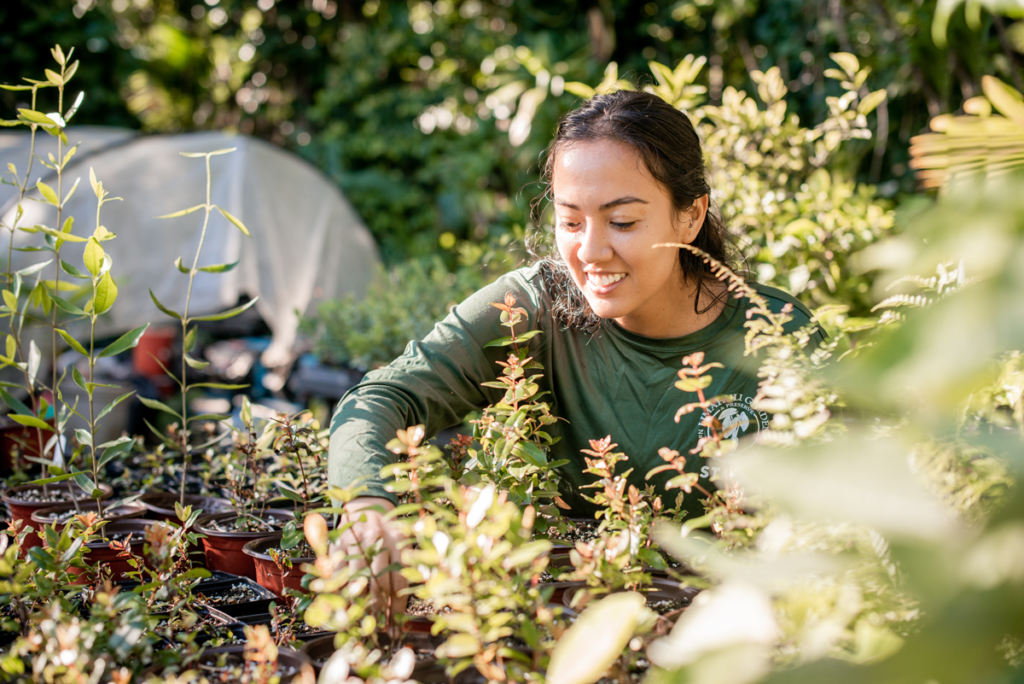
Growing up in California’s Inland Empire, Kassie Jensen was surrounded by citrus orchards. As a student, her interest in animal science led to learning about agriculture and eventually serving as a Peace Corps volunteer in West Africa. When the pandemic cut that endeavor short, a friend told her about Kupu, AmericCorps’ Hawaiʻi-specific conservation leadership development program.
With a growing interest in plants and tropical conservation, Kassie applied to be a Kupu member doing conservation and ecology work at Limahuli Garden and Preserve. Arriving at Limahuli in 2020, she says, was a “lucky coincidence.”
Although she originally planned to do only one eleven-month stint, she realized that Limahuli was where she wanted to be and what she wanted to be doing. After nearly two years working in Limahuli’s upper and lower preserve as a conservation technician, Kassie is preparing to start graduate school at the University of Hawaiʻi in the fall. Kassie talks about her involvement with NTBG below.
What were you doing when you started with NTBG at Limahuli?
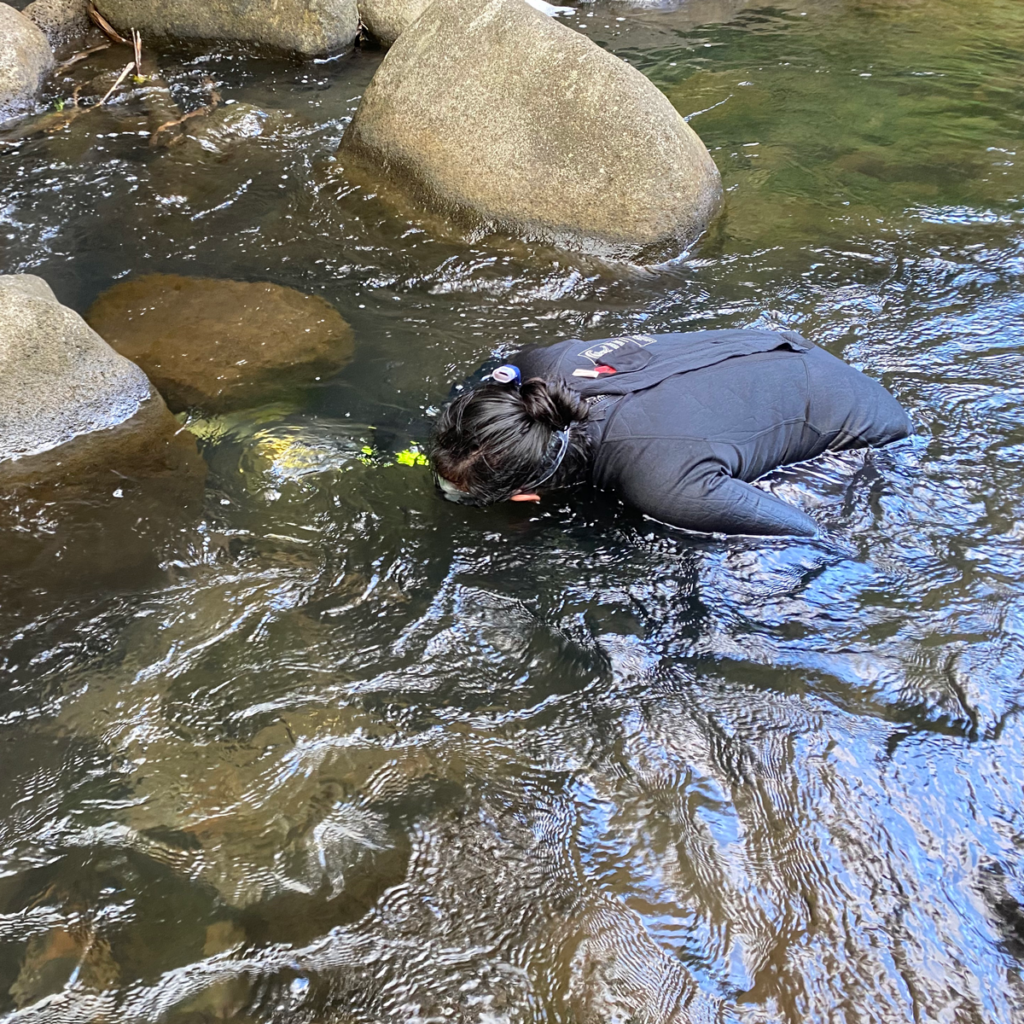
I worked four days a week in the lower preserve and one day in the garden. We removed non-native plants and planted natives from NTBG’s south shore nursery. I also did stream surveys— counting oʻopu fish—and other restoration work.
Are you still doing stream restoration?
We aren’t counting fish anymore, but we are doing riparian restoration.
What was it like working inside Limahuli Stream?
I thought it was really fun. It was challenging at first—the stream was really cold and half the time it was raining—but my teacher, Puakea, was really great.
What is something meaningful that you learned as a Kupu member?
Working in the Lower Limahuli Preserve taught me about dedication to the work and kuleana (responsibility), and the strong work ethic of everyone here because this is the work we want to do—helping the community.
Did this experience change your relationship with plants?
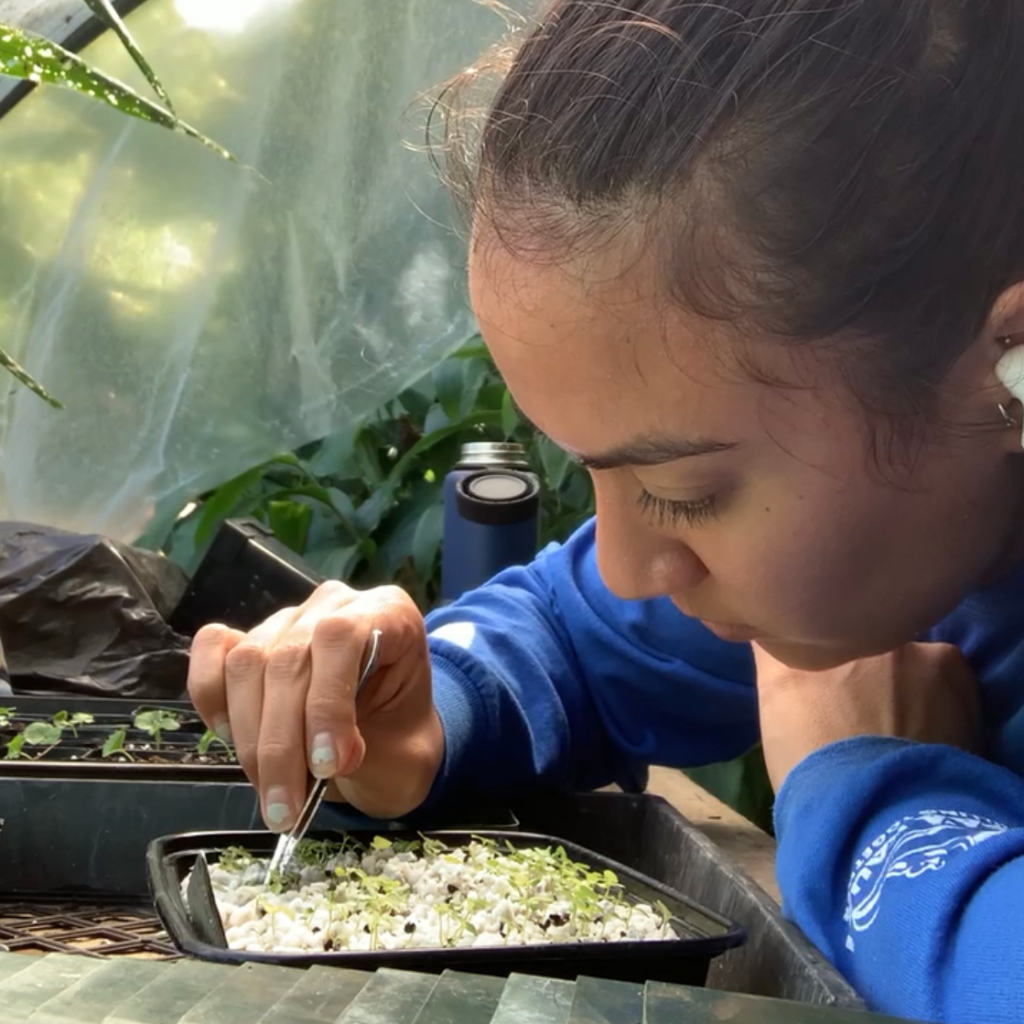
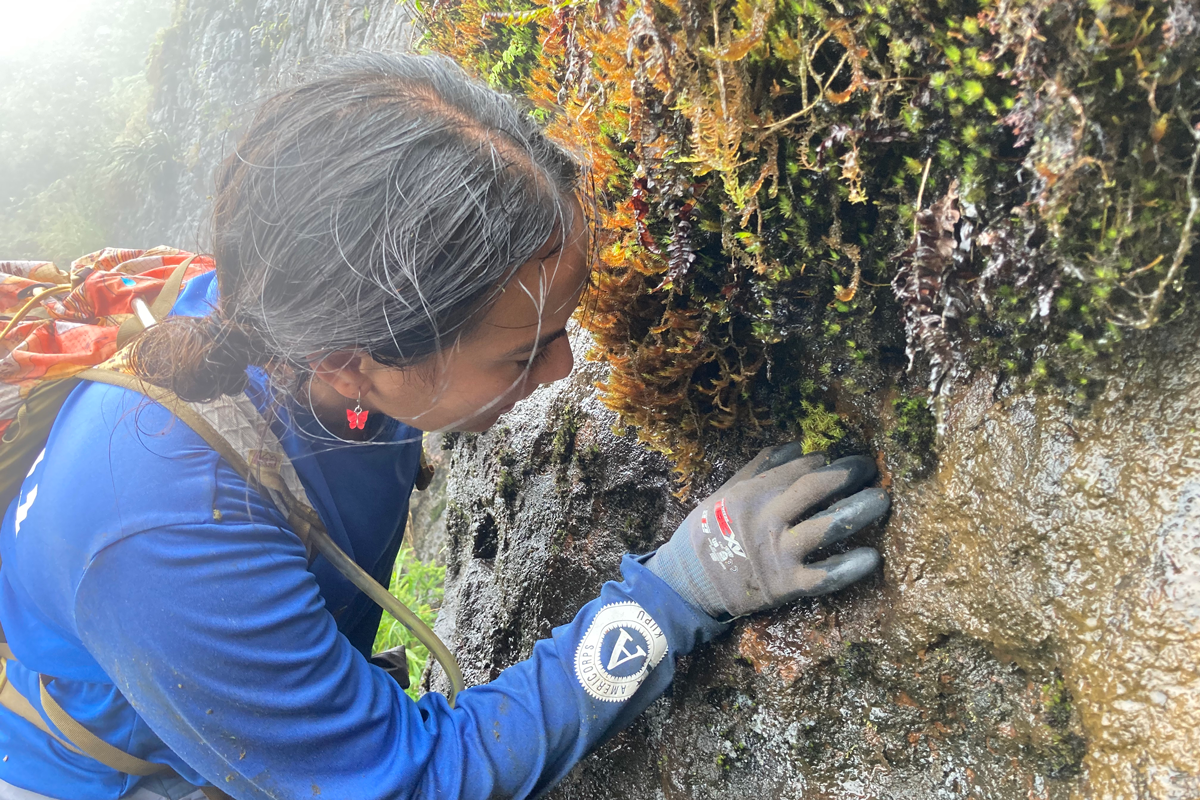
In the Upper Limahuli Preserve, I became really enthusiastic about mosses. Once we did an all-day moss lesson. I am from a really dry desert-like area where we don’t have these beautiful, flamboyant mosses.
How did your interest in mosses begin?
One of my first days hiking around I saw this beautiful moss and said, “what is that?” It just spiraled from there. I am actually going to start graduate school in the fall at the University of Hawaiʻi to research mosses. I didn’t have any experience with moss before and now it’s my specialty and my life. I realized this is what I want to be doing and this is where I want to be. I am working as a research assistant for school through a lab doing research at Limahuli so I will be able to keep coming back.
Do you feel this internship has influenced your future academic plans?
Absolutely. Under the guidance of NTBG staff like Dr. Uma Nagendra who recognized that I was interested in mosses and said, “we should pursue this.” She had me start one project which led to another. That led to the publication of a checklist of the mosses of the lower Limahuli Preserve which has been accepted into Hawaiʻi biological surveys through Bishop Museum.
Did specific NTBG help guide you?
Yes, I consider the curator of the herbarium Tim Flynn and Uma as my mentors.
What is the value of supporting internships like the one you did?
We need people to be doing this work. We have to get people interested. Unfortunately, a lot of people don’t have the choice. Of course, it’s valuable because we really need to do this work if we want the island to remain this way. If we want to get people interested, they have to be supported financially.
People need plants. Plants need you.
Plants nourish our ecosystems and communities in countless ways. When we care for plants, they continue caring for us. Help us grow a brighter tomorrow for tropical plants.
The Fertile Soil of Memory
Renewing the future for cherished plants by tending our past
By David Bryant, Director of Communications
Nani wale nā hala ʻeā ʻeā o Naue i ke kai ʻeā ʻeā …so begins Nā Hala O Naue, a famous ode to a cherished grove of hala (Pandanus) trees that once shaded Naue Beach on Kauaʻi’s North shore. But today this forest “drenched in fragrance” and “swaying close to Hāʻena” has been all but lost.
The iconic hala tree spirals skyward atop stilt-like roots, their leaves exploding in tropical rosettes. These leaves are literally woven into Hawaiian culture, used for sails, baskets, apparel, and much more.
Hala’s chunky yellow, orange, and muted brown fruits add to the plant’s flamboyance. But it’s the elegantly small, red fruit for which Naue hala is renowned.
What happened to the beloved hala grove of Naue? Siblings Violet Hashimoto-Goto and Thomas Hashimoto, born in Hāʻena in the 1930s, say many of the trees were destroyed by a tsunami in 1946. NTBG’s former president Chipper Wichman adds, “When I was growing up, the tidal wave of 1957 had just occurred and Naue had been completely flattened. The combination of the two tsunamis did indeed wipe out all that remained of the hala grove at Naue.”
Lei Wann, director of Limahuli Garden and Preserve, whose family is from Hāʻena, has spent decades in search of the elusive Naue hala. For her, reviving these trees is a vital component of preserving her community and culture. “These plants hold stories and reawaken our genealogical connections,” says Lei. “They are living artifacts that transcend time and weave our stories together.”
(L) Lei Wann, director of Limahuli Garden and Preserve. Photo by Erica Taniguchi. (R) The red fruit of the Naue Hala.
Growing up, Lei heard murmurs about Naue hala still found in backyards and in memories. These leads would surface, only to vanish. There was fear that the famed red hala of Naue was forever lost.
When Lei celebrated her son Hanalei’s high school graduation, hala lei were everywhere. Hala in Hawaiian signifies “to pass.” The garlands of hala are a deeply symbolic gift representing a passage or transition. As they celebrated, Lei’s family sang and reminisced about the Naue hala grove, recalling the tree’s red fruits. At that moment, Hanalei’s father shared an epiphany with Lei: didn’t the hala trees growing on their Kalapana home on Hawaiʻi Island also have red fruit?
He recalled decades earlier when a family friend, the late kumu hula and lei master Dana Valeriano “Kauaʻiʻiki” Olores, presented a red hala lei at the funeral of Lei’s mother-in-law on Hawaiʻi Island. On that solemn occasion, the lei, made with fruits from a tree on Kauaʻi, symbolized the passage and transition after death. He remembered his brother had buried the fruit from the red hala lei in the yard at Kalapana. A quarter of a century later, prompted by these memories, Lei traveled to visit the hala tree that had sprouted at Kalapana. It was full of red fruit.
Today more than 50 descendants from the hala of Naue are being grown in Limahuli Garden’s nursery. Many of these young trees will be given as a gift for use in a restoration project by the YMCA camp at Naue Beach.
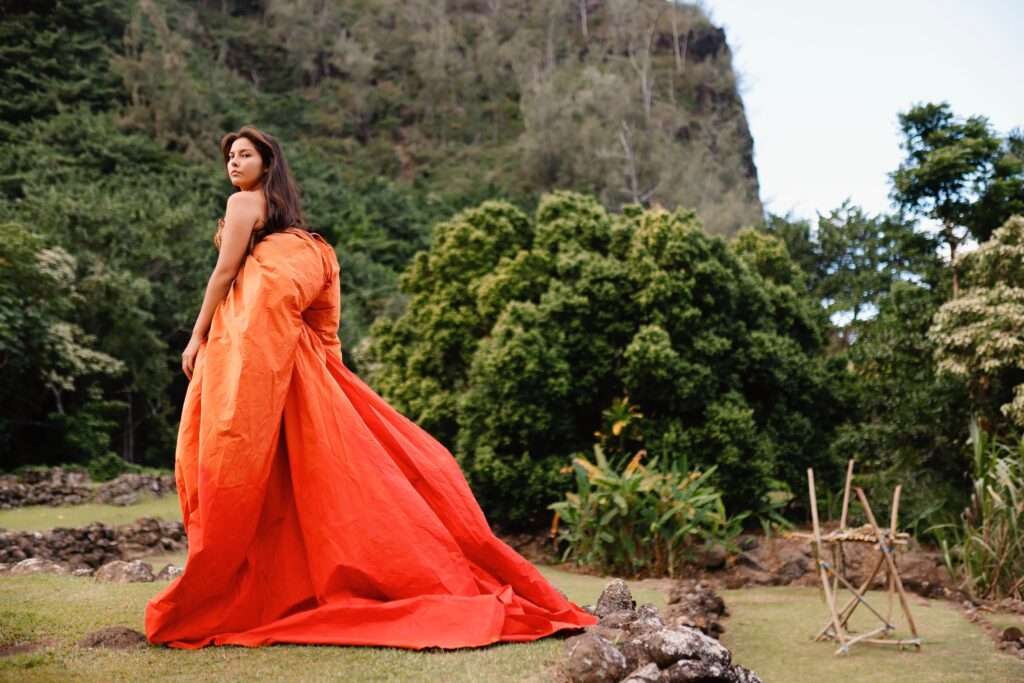
Dress by Rocket Ahuna modeled by Helena Ng. Photo by Kilikai Ahuna.
As the Naue hala reawaken in Hāʻena soil, community connections to this plant and place are coming alive too. After Lei shared her story of the Naue hala with Hāʻena descendant and fashion designer Rocket Ahuna, he was inspired to create a dress that reflected the trees and the spirit of the land in its design. That dress won the Critic’s Choice Award at the 2022 Fashion Institute of Technology exhibition in New York.
Lei said that by sharing the seeds and her story of Naue hala, Rocket could connect with his past to “see what our ancestors were seeing when they wrote songs or perhaps made clothing inspired by these same trees.”
Lost and found
Like the family memories that changed the fate of Naue hala, another recollection helped save a species known only from the precipitous sea cliffs of Kauaʻi and Niʻihau.
That plant is the ʻālula (Brighamia insignis), a remarkable succulent which is now believed to be extinct in the wild. However, thanks to the extreme measures NTBG staff and others have gone to preserve it, ʻālula now number in the thousands in gardens and nurseries worldwide.
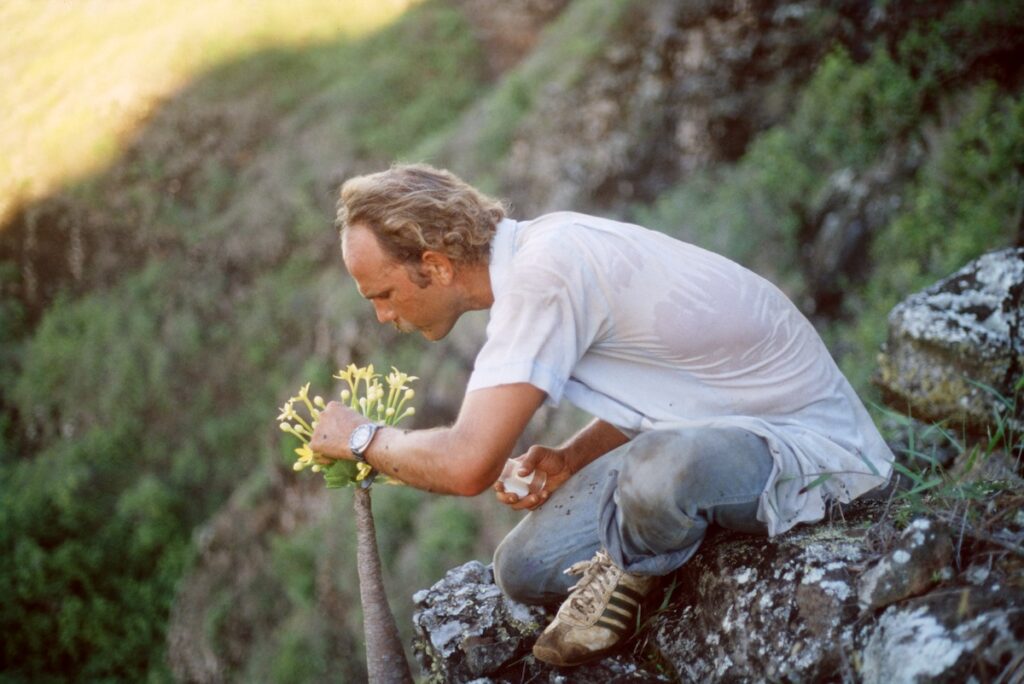
Steve Perlman with a wild ʻālula in 1978.
Although the story of ʻālula has become closely associated with NTBG’s history, few have heard a nearly forgotten chapter of how family memories aided in the conservation of this imperiled species.
In the 1970s, Chipper Wichman and Steve Perlman spent years searching for the elusive ʻālula. Despite reports that the plant was growing on Kauaʻi’s Hāʻupu mountain range, their surveys had been fruitless. Their luck changed when Chipper’s grandmother Juliet Rice Wichman recounted how, as a young girl around 1910, while attending a lūʻau at the canoe club in Nāwiliwili, she saw two boys swim across the Huleʻia Stream. When they returned, they had collected ʻālula from the bottom of a cliff.
Based on this memory, Chipper and Steve mapped out possible locations and, aided by the decades-old story, discovered 12 new plants. The recollection of memory played a critical role in saving the ʻālula.
Goddess of the forest
Just as our memories can preserve our relationships with plants, so too can they illuminate new paths forward in the conservation of endangered flora. Mike DeMotta, NTBG’s curator of living collections, is an expert in the cultivation of Hawaiian plants who brings together decades of horticultural experience and generations of ancestral plant knowledge.
Mike’s early love for plants was shaped by hula, an aspect of Hawaiian culture deeply rooted in plants. Laka, goddess of both hula and the forest, is embodied in plants like ʻōhiʻa, hala pepe, and palapalai ferns. The dances, songs, and chants that Mike learned in his hula practice are homages to these beloved plants.
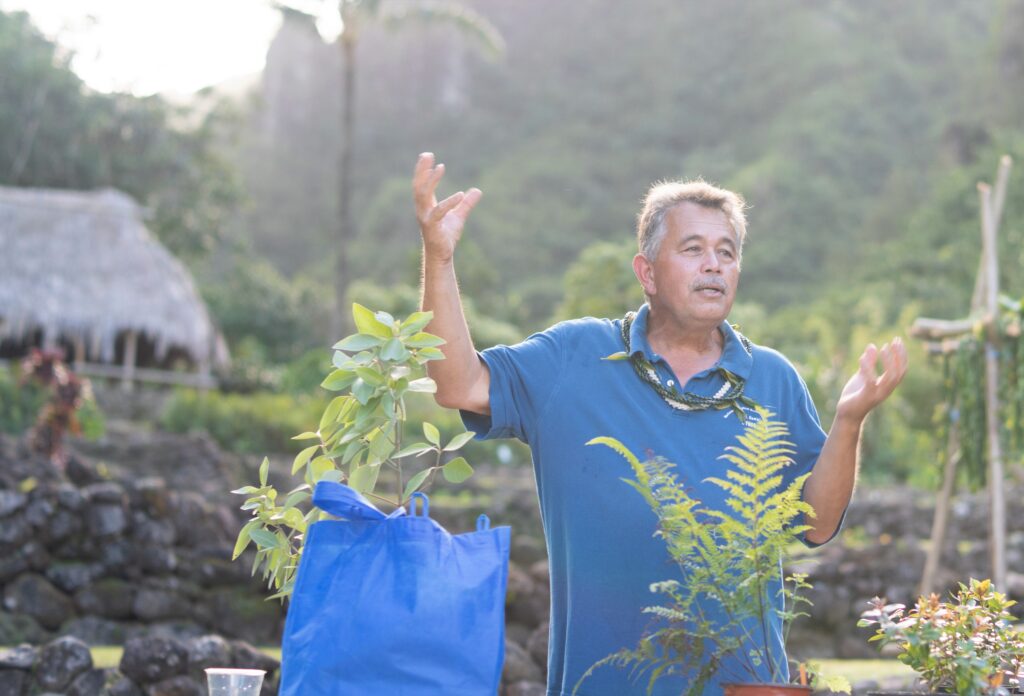
Mike DeMotta, NTBG’s curator of living collections. Photo by Neal Uno.
In his youth, Mike gathered plants in the Koʻolau Mountains for making lei. He also observed his elders use plants as herbal remedies, and listened to the moʻolelo (stories) of the plants like kalo (taro) and ʻuala (sweet potato) that sustained his ancestors. Decades later, Mike cares for plants guided by a philosophy that weaves together these cultural and ecological connections.
“I’m interested in native plants because of the inseparable bond between them and early Hawaiian culture,” Mike says. “I feel responsible for doing whatever I can to perpetuate native plants because they are an important part of the ecosystem.”
Today, Mike can often be found in NTBG’s Fern Lab, surrounded by sporelings from both common and critically endangered species. While ferns provide critical ecosystem services and are integral to Hawaiian culture, horticultural knowledge on growing these species is still relatively limited. To propagate native ferns successfully, Mike has relied on the memories and legacies of many collaborators. As he works amongst the ferns in the lab, Mike takes comfort knowing that he is surrounded by Laka as she comes to life in the many pots and growing containers around him. She nurtured him, and his ancestors, through hula and a lifetime in the forest. He is happy and committed to returning the favor.
NTBG represents an invaluable sanctuary for biocultural diversity. Successfully growing the world’s rarest plants and restoring them in their natural habitat and in managed settings, requires technical skills, life-long commitment, and resources. It also demands a respect for memories passed on by ancestors, elders, and present-day partners. Nourished by these memories and bolstered by a commitment to preserving culture and community, NTBG continues to perpetuate plans and the ancestral knowledge to sustain them.
As we work together to restore relationships between plants, places, and people, our path forward is constantly illuminated by our past. If you think about it, life-sustaining plants like kalo have never stopped growing since their original cultivation. Passed between hands and generations, islands and eras, the regenerative rhizome of kalo has kept roughly the same plant alive throughout time. The kalo in Hawaiʻi’s loʻi today carry that genealogy. It is up to us to keep plants flourishing for future generations. Thankfully, we have the knowledge and love of many ancestors to keep us growing.
People need plants. Plants need you.
Plants nourish our ecosystems and communities in countless ways. When we care for plants, they continue caring for us. Help us grow a brighter tomorrow for tropical plants.
Hope for Habitat
People need plants. They are the root cause of our health, habitat, and happiness. More than ever, plants need you. Join us this fall as we explore how cultivating deeper connections with plants can grow a brighter tomorrow for our ecosystems and communities.
Our homes and habitats are made possible by healthy plant communities
Where are you at this moment? Whether you’re surrounded by wildlife or citylife, you’re in a habitat that is alive with relationships. Species and soil, climate and community, wind and water are working together to make life possible. A Hawaiian proverb reads I ola ‘oe, i ola mākou nei. “My life is dependent on yours, your life is dependent on mine.” Everything in your habitat is intimately connected.
(L) Uma Nagendra admires an ohia lehua. (R) A rock islet in Palau photographed on a recent expedition by Ken Wood
In many ways, plants are the threads that weave this tapestry together. They stitch together entire food webs and provide a patchwork of so many other necessities, down to the very air we breathe. However, in a rapidly changing world, plants and plant communities are disappearing. Each plant lost is a thread cut from this vibrant tapestry, an end to a network of relationships and a potentially reshaped habitat. To restore habitats, it’s vital to rethread them with their unique plants that are a support system for the life they sustain.
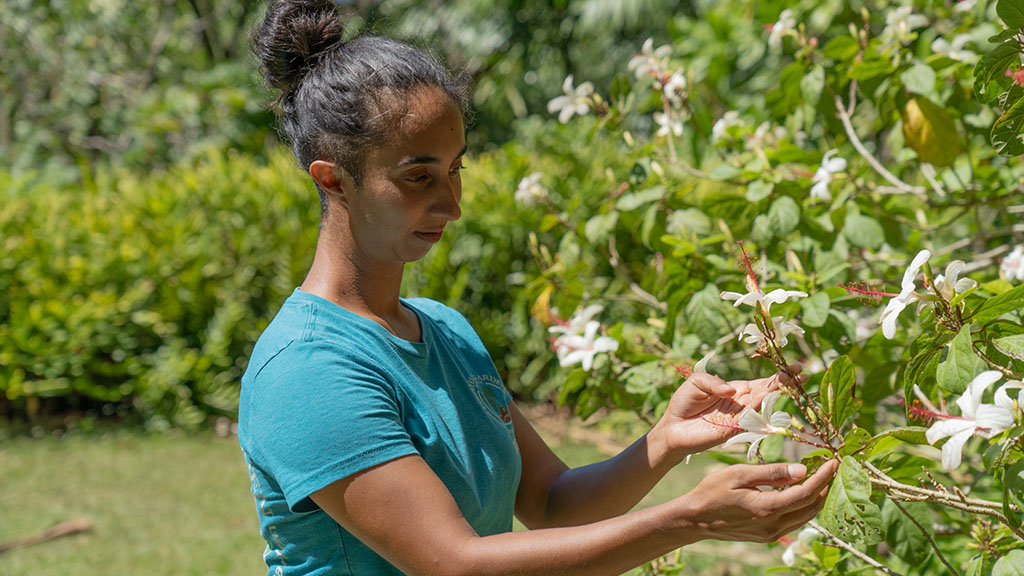
Uma Nagendra inspects the beautiful flowers of kokio keokeo (Hibiscus waimeae subsp. hannerae)
Plants are a habitat’s best friend
At this moment, there is a good chance that Uma Nagendra is in the habitats of Limahuli Garden & Preserve. As the Conservation Operations Manager there, she works to understand and restore Hawaiian ecosystems in the face of constant change. Limahuli on Kauai is considered one of the most biodiverse valleys in Hawaii. To perpetuate the environmental integrity of this invaluable place, Uma relies on plants. “Plants are the foundation of nearly every ecosystem – they don’t just enhance the ecosystem, they create it!” shares Uma. “Here in Hawaii, ohia and other montane trees capture mist from the clouds and gather raindrops, forming the cloud forest that feeds all the rest of Hawaiian streams. Their nectar feeds the forest birds; their bark houses mosses, insects, and snails; their roots shelter seabird burrows.”
Limahuli Garden and Preserve totals over 1,000 acres and are managed within an ahupuaa framework, continuing a living legacy of indigenous stewardship. Ahupuaa are Hawaiian land divisions that extend from mauka (mountain) to makai (ocean). Within this framework, humanity and nature are inseparable. The same water that condenses atop the highest ohia in the ahupuaa makes its way through misty falls and mesic forests, through loi kalo (taro terraces) and rushing streams out into a bustling reef. At every section of the ahupuaa, plants sustain life for the ecosystem and community alike.
On a daily basis, Uma experiences the biodiversity that plants make possible in Limahuli’s preserves: Tiny land snails sneaking by on haha (Cyanea spp.) leaves, pueo owls in courtship, Tetragnatha spiders in “full arachnid-yoga poses,” apapane birds diving across the ohia canopy, the barking sounds of ao (Newell’s shearwater), hundreds of opae kuahiwi (mountain shrimp) darting in the stream. All of these precious residents of Limahuli depend on the ahupuaa’s native plants. Without them, Limahuli wouldn’t be the same. “A forest in Hawaii dominated by invasive guava will feel completely different from a diverse ohia forest,” says Uma. “In the ohia forest, you’ll see a wider variety of textures and layers, you’ll feel the moisture hanging in the air, you’ll feel the spongy moss cover beneath your feet, perhaps you’ll even hear more birds and other animals enjoying the trees. Because plants are the foundation for everything else, it truly matters which plants are the ones building that foundation.”
“We can all do our part to make sure our habitats have the support system they need.”
Uma Nagendra, Conservation Operations Manager
Uma and her team work to safeguard and restore the habitats of Limahuli. You can help be the support system for the habitat you call home. “We can all do our part to make sure our habitats have the support system they need by limiting the impact of existing invasive plants, animals, and microbes; avoiding introducing new ones when we enter wild places; and not exacerbating climate change.” Find out what invasive species are impacting your habitat and what native plants share your home. Building awareness and knowledge about the plants that define your habitat is a great step towards caring for the special place you live.
To help us root more deeply into the habitats that support us, Uma recommends a recurring meditation. “Find a quiet moment where you can observe your outdoor surroundings. It doesn’t matter if you’re in an urban environment, rural, suburban, or wilderness – all of these are ecosystems. Try for 15 seconds of stillness, then observe with as many senses as you can. Do you hear or see any animals or plants? What textures, air currents, warmth, or precipitation is present? Repeat the exercise weekly. Can you notice when the seasons begin to change? What animals and plants are active or migrating at different times of the year? Does the air feel different to you as the months roll on?”
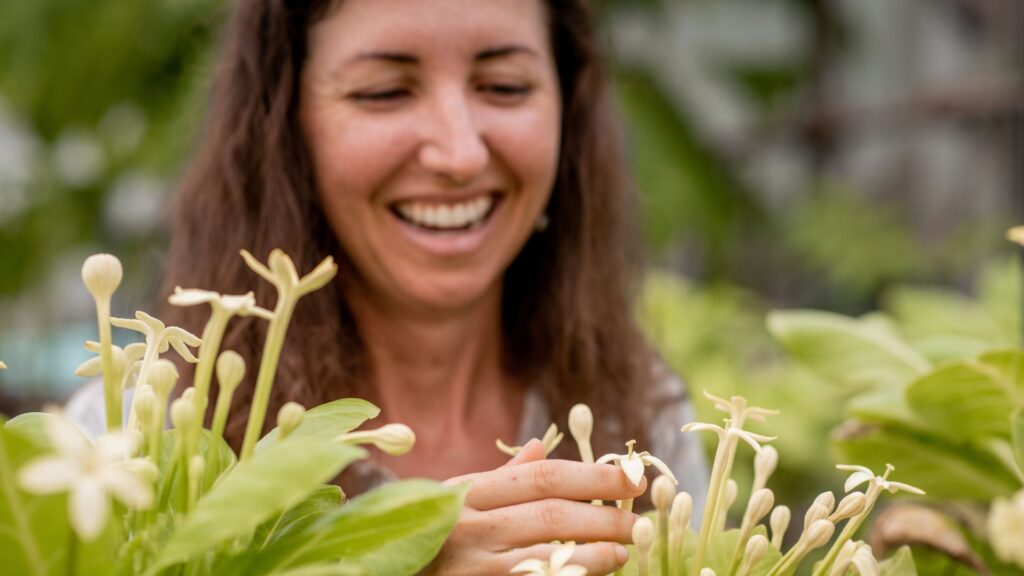
Seana Walsh admires alula (Brighamia insignis) flowers at NTBG’s Conservation Nursery
Hope for plants means hope for habitat
Seana Walsh, NTBG’s Conservation Biologist, has been growing a brighter tomorrow for the beloved alula (Brighamia insignis) for over seven years. While extinct in the wild, these charismatic plants that once adorned sea cliffs on Kauai and Niihau have made their way across the world in botanical garden collections and as indoor houseplants. Seana is leading a cutting-edge study to strategically breed these cultivated alula to enhance diversity and plant health. While this strategy has been used in zoos for decades, this major undertaking is one of the first of its kind for plants. Seana’s work with alula is perpetuating a beloved plant for Hawaii. At the same time, she is helping to develop and inform strategies for perpetuating plants—and the habitats they sustain— across the world.
(L) Alula (Brighamia insignis) in bloom. (R) A Molokai alula (Brighamia rockii) at home on a sea cliff
For Seana, bringing plants back from the edge of extinction is a moral obligation. She grew up on the leeward side of Maui, where invasive species and degraded landscapes provided a stark comparison to the native plants and habitats she now nurtures. “Knowing what I know now, and what I experience during my time and work in the forest, it is very clear how different a healthy, native forest both looks and feels compared to one dominated by non-native species,” Seana says. “In a healthy native forest, you won’t see large areas of bare soil or pooling water. Non-native forests with exposed earth cause runoff when it rains and pools of water which are breeding grounds for mosquitoes, a huge threat to our native forest birds. A native forest results in less runoff which equates to more groundwater recharge and less sediments flowing downstream and covering our reefs.”
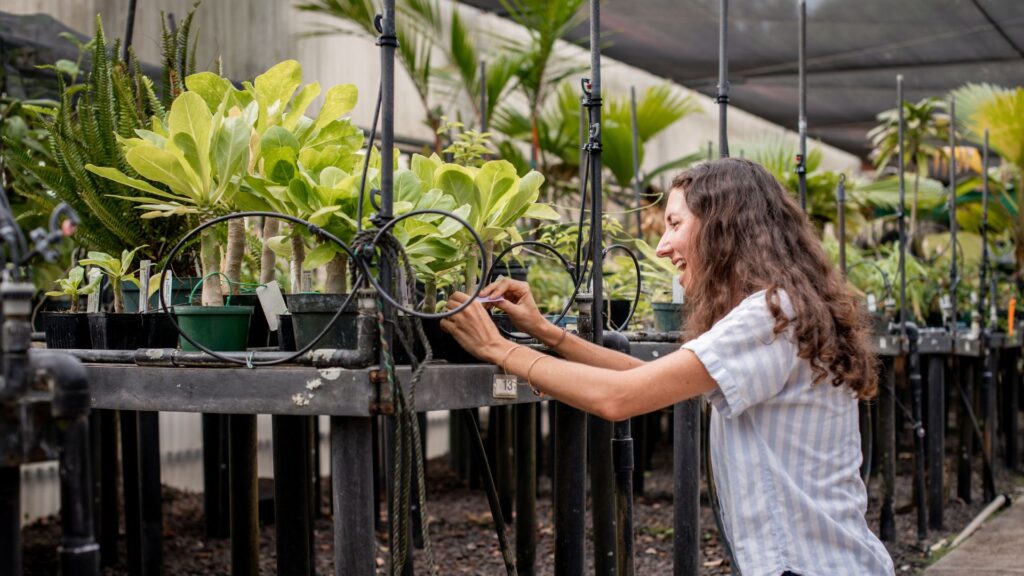
Kampong by Christina Pettersson
Plants make home, home
Healthy habitats and communities rely on plants. By tuning in to the habitats we call home and the plants that define them, we can learn how to be a support system for the places we love.
People need plants. Plants need you.
Plants nourish our ecosystems and communities in countless ways. When we care for plants, they continue caring for us. Help us grow a brighter tomorrow for tropical plants.
Five Ways to Give on Giving Tuesday
Everyone can have an impact on #GivingTuesday! Join NTBG on November 29 by pledging your time, skills, voice, or dollars to grow a brighter tomorrow for the tropical plants that sustain and nourish us all. Add Giving Tuesday to your calendar and be sure to follow us on social media!
Five Ways to Give on GivingTuesday
Give money
Donate to NTBG, purchase, renew or gift a membership.
Interested in making a difference year-round? For as little as $10 a month, your monthly pledge helps provide NTBG a steady stream of support no matter how uncertain the times may be. Thank you for considering this helpful option.
Give Your Voice
Speak up! Talk to your friends and family about saving plants.
Need some tidbits to share with the people in your life? If you don’t already, follow us on social to keep up with the latest! Check out our news page for updates on our work and subscribe to our newsletter to stay in the know.
Give Your Time
Volunteer or donate your skills to NTBG.
Interested in becoming a volunteer? Click the button below to explore opportunities.
Give Goods
Buy an item from the NTBG wishlist.
Purchase an item from our wish list and your donation will go directly to meet immediate program needs.
Inspire Others
Organize a fundraiser or share your story online.
Share why you support NTBG with the world! Need a place to start? Download this #unselfie template and tell your story on November 29, 2022.
Even More Ways to Give
Global biodiversity is in crisis. Today we are at risk of losing plants faster than we can discover them. Your partnership and steadfast support help us continue our science, conservation, and research efforts in Hawaii, Florida, and around the world.
How a Garden Can Save a Stream
Restoration efforts in Limahuli Valley show how a garden can save a stream.
by Dr. Uma Nagendra, Conservation Operations Manager, Limahuli Garden and Preserve with Puakea Moʻokini-Oliveira, Conservation Technician
In the middle of Limahuli Stream, cold mountain water cascades down boulders into a hip-deep pool. I am grateful for the wetsuit keeping me warm. Small river stones slick with algae slip beneath my tabis (water shoes). If I stay still, I might feel the dull pinch of Tahitian prawns nibbling my toes. Looking up at Limahuli Valley, I can see both sides of the cliffs where koae (white-tailed tropic birds) dart into their nests. I don my snorkel mask, nod to lead technician Puakea Moʻokini-Oliveira, who is standing on the bank with a timer and waterproof datasheets, take a deep breath, and dunk myself into the frigid water to enter the aquatic world of freshwater fishes.
Immediately, several oopu nakea[1] dart away along the stream bottom, leaving silty clouds in their wake. As I step in their direction, I can see an oopu alamoo resting on a dark stone, its bright orange tail curled slightly against the rock contours. I almost miss the crowd of oopu nopili grazing on a patch of green algae because they are so close to the waterfall cascade.
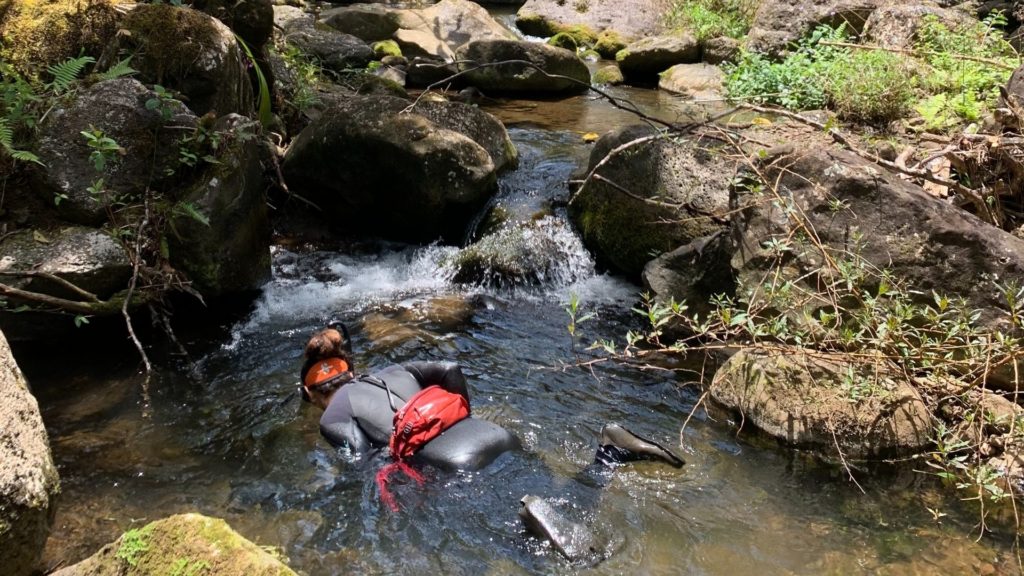
This underwater survey is a component of The Haʻena ʻOʻopu Restoration Project, a two-year project funded by the Hawaii Fish Habitat Partnership in order to enhance stream health and oopu population numbers in Limahuli Stream. Freshwater aquatic species like oopu were once a major food source, although now few Hawaii residents have ever seen one.
While this underwater world may feel completely removed from the terrestrial world we inhabit at NTBG, they are actually intricately intertwined. Limahuli Stream is the thread connecting all parts of the watershed from mauka to makai (mountains to the sea). From the mist caught by the ohia (Metrosideros sp.) canopy in the uppermost valley, filtered down through moss, leaf litter and soil, flowing underground through porous rock, or overland in rivulets and gulches, all the valley’s water eventually follows Limahuli Stream to the ocean.
“In Many ways, the health of the stream indictes the health of the rest of the valley.”
Dr. Uma Nagendra, Conservation Operations Manager
Streams carry carbon, nutrients, and silt to the reef. Riparian ecosystems (streams and stream banks) offer unique habitats for plants and animals that are adapted to constantly moist, periodically flooded conditions. In many ways, the health of the stream indicates the health of the rest of the valley. Healthy streams also provide critical ecosystem services such as clean water, erosion prevention, and food.
With the abandonment of traditional stream management practices and introduction of invasive species, stream health has declined throughout Hawaii. Stream diversions, blockages, and invasive species overgrowth have adversely transformed many riparian systems that were once highly productive and biodiverse ecosystems.
Although Limahuli Stream is considered “pristine,” with high levels of biodiversity and among the least disturbed stream systems on Kauai, it is home to far fewer oopu than neighboring Hanakapiai Stream. A past comparison of the two suggests that the amount of sunlight reaching the streams could be a major contributing factor to the lower population in Limahuli. Native green algae are the foundation of the riparian food web, and thrive in high light conditions. A promising pilot study led by NTBG research associate Kawika Winter[2] several decades ago tested this idea on a small scale. The Hāʻena ʻOʻopu Restoration Project expanded that study in order to see if opening up longer sunny stream corridors (as would have been maintained with traditional stream management) would also increase green algae growth and oopu populations.
One of the main activities of this project was the selective trimming of Schefflera actinophylla, a highly-invasive tree species that threatens the health and resilience of the riparian ecosystem by preventing sunlight from reaching the stream, which limits green algae growth. The tree’s high evapotranspiration rates and inhibition of understory growth reduce groundwater penetration and storage, contributing to flash floods and erosion. Schefflera’s sprawling growth forms also threaten the integrity of valuable cultural resources. For this project, invasive trees were trimmed by an experienced local arborist crew (Haleleʻa Tree Service), with the help of Limahuli Garden staff.
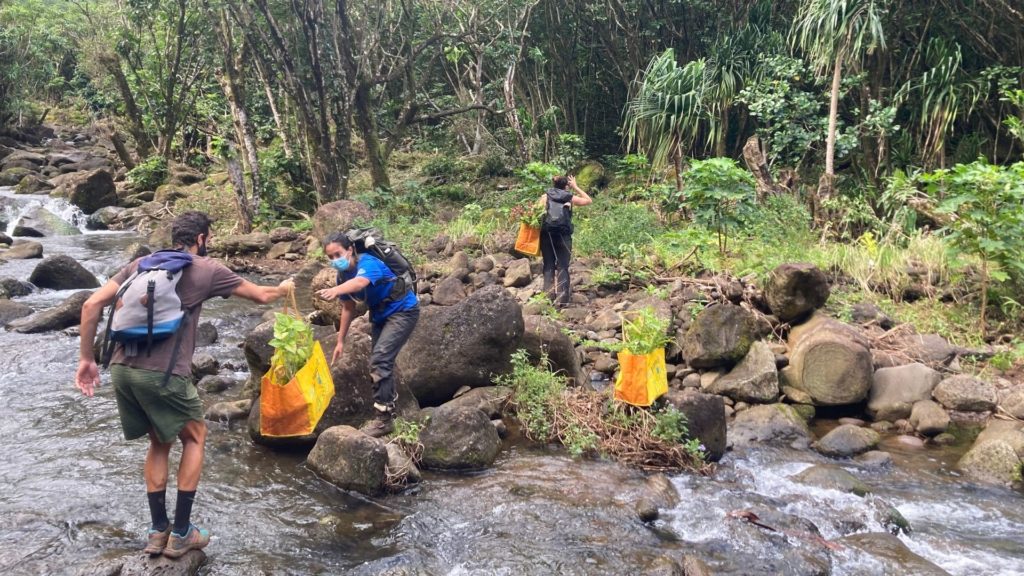
Afterwards, Puakea and I started planting on the freshly cleared stream banks, with the help of many other Limahuli staff, KUPU service members, and volunteers. We hand-carried and planted over 4,742 native plants like kokio keokeo (Hibiscus waimeae hannerae), hala (Pandanus tectorius), and many others[3].

The mix of species was selected in consultation with previous restoration managers and living collections experts at NTBG. These included species sourced from northwest Kauai, quick to establish and grow in riparian areas, and which have strong root systems that will help prevent future erosion on a now-vulnerable stream bank. We also chose a few species that are likely pollinated by moths (scented, white, night-blooming flowers) in order to further promote moth habitat, including endemic Hyposmocoma and the opeapea (Hawaiian hoary bat) that feeds on them.
Throughout the project, Puakea conducted stream surveys to assess how the aquatic wildlife were responding to this change. The entire 1,500-foot restoration area was divided into three 500-foot sections where we swam for an underwater census of the aquatic animals. We also surveyed a cross-section of different parts of the stream to document the algal growth, substrate composition, and stream characteristics like water temperature, flow rate, and canopy openness.
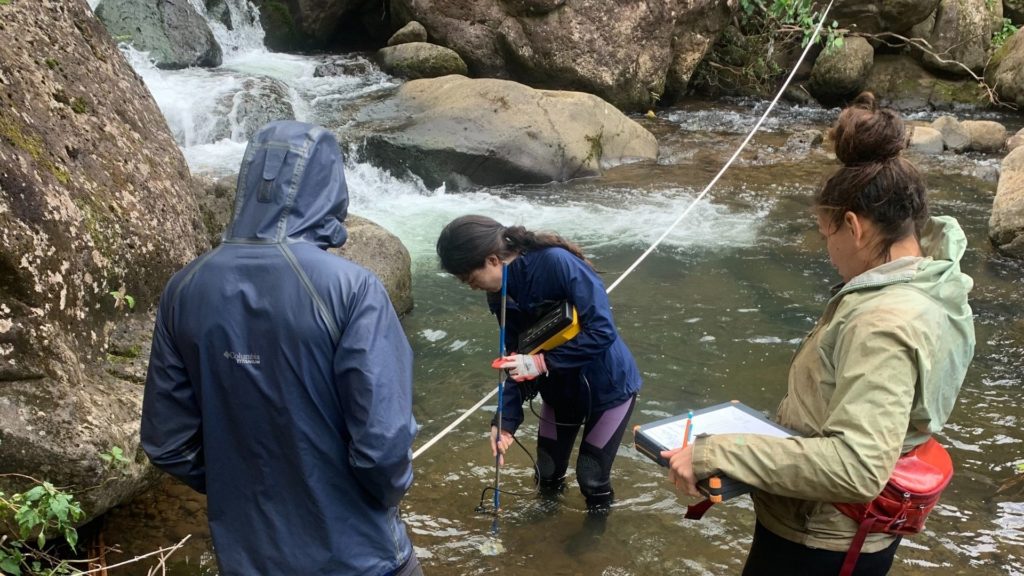
Spending so much time along the stream banks allowed us to observe just how many other species enjoy this area as well. By investigating the lower stream, Puakea was able to note how hīhīwai[4] migrated up the stream into our restoration zone — and even spotted their small pink eggs on the rocks. While we planted or weeded, we were often joined by an aukuu (Black-crowned Night Heron) standing statue-like to fish on a nearby boulder, or a pair of Koloa maoli ducks playing in the current.
One of the best parts of this project was working with school groups, volunteers, and partnering community organizations. Although COVID precautions limited our interactions after the first six months of the project, we were able to welcome two recurring classes from Kanuikapono Public Charter School, a work-exchange with the Waipā Foundation, and a new stream research collaboration led by the non-profit Nā Maka Onaona.
Our results indicated that canopy openness alone was not enough to boost oopu population numbers within the time frame of this project. Aquatic animal diversity remained high, however, and indicators of stream health such as temperature were unchanged. By restoring the stream banks to native habitat, the stream corridor should now be even more hospitable to native birds, bats, and invertebrates, and safer from the invasive tree falls that exacerbated flood impacts in 2018.
The completion of this project is just the start of this important new restoration area. In order to sustain those benefits, we will need to continue maintaining the stream corridor. Ongoing collaborative stream monitoring will also help improve our understanding of watershed resilience both in the Limahuli Valley and in freshwater systems all across Hawaii.
Editor’s note: The author wishes to thank those who contributed significantly to this project: Kawika Winter, Ashley Ramelb, Saori Umetsu, Moku Chandler, Noah Kaaumoana, Pelika Andrade, Mackenzie Fugett, Lauren Pederson, Matthew Kahokuloa Jr., Kassandra Jensen, Joshua Diem, Emma Stauber, and others. Funding for this project was provided by The Hawaii Fish Habitat Partnership, which is coordinated by the U.S. Fish and Wildlife Service.
[1] ʻOʻopu are species (Awaous sp.) of goby native to Hawaii. The three most common ʻoʻopu in Limahuli stream are ʻoʻopu nākea (Awaous guamensisi), ʻoʻopu alamoʻo (Lentipes concolor), and ʻoʻopu nōpili (Sicyopterus stimpsoni)
[2] Dr. Kawika Winter was director of Limahuli Garden and Preserve from 2005 to 2018.
[3] Including koaia (Acacia koaia), māmaki (Pipturus kauaiensis), ʻākia (Wikstroemia oahuensis), koʻokoʻolau (Bidens forbesii forbesii), and ground covers such as ahuʻawa (Cyperus javanicus), makaloa (Cyperus laevigatus), pili (Heteropogon contortus) and ʻaeʻae (Bacopa monnieri).
[4] Endemic freshwater snail (Neritina granosa)
Hawaii Education Series
Plants are the basis of healthy ecosystems from ridge to reef across Hawaii. The islands have truly unique and diverse ecosystems that provide our communities with a myriad of critical resources.
NTBG’s Hawaii Education Series provides students and families with fun and inspirational videos and activities exploring the plants, cultural resources, and people that make Hawaii special. Explore the videos below and check out more resources on our education page.
Hawaii Education Series: Ferns
Ferns are among the oldest living plants on the planet and play many important roles in their ecosystems, especially in Hawaii. Check out this video to get a quick overview of ferns in their natural environment, fern anatomy, fern lab propagation, and a fun experiment to do at home or in the classroom!
Hawaii Education Series: Canoe Plants
The landscape of Hawaii is filled with what we refer to as ‘canoe plants.’ These plants might even be growing in your school playground! So, what is a canoe plant? Canoe plants were brought to the Hawaiian Islands by our ancestors, the Polynesian voyagers. Check out this video to get a quick overview of canoe plants and a how-to on making a Ti (Ki) leaf lei.
Hawaii Education Series: Ahupua’a
Learn about traditional Hawaiian land management systems (Ahupua’a) through a virtual visit to NTBG’s Limahuli Garden and Preserve. Humans have inhabited and cared for Limahuli valley for over a thousand years. It is home to many of our native plants and animals like our native ʻaʻo, moths, ‘o’opu, laua’e ferns, papala trees, and so much more.
5 Reasons to Plant Native Plants
All native plants in peoples’ home landscape help preserve biodiversity. This is important for the future conservation of native species. Want to be a good neighbor to Hawaii’s native flora? Learn more about gardening with native plants at ntbg.org/gardening and do your part to save plants today.